Blog

What motivates swimmers to take part in 8 Bridges?

By Liz Morrish

It is 6.45am and swimmers, volunteers, boaters and organisers are assembling at Dutchman’s Landing, Catskill New York. Many of us haven’t met before, but it seems already as if people are gelling into their assigned roles.

This is the meaning of team work and it is the swimmers who are at the centre of this event. Everybody is here to make sure that they swim their swim. This explains why all the volunteers are here, but why did the swimmers themselves choose to participate in this particular event?

The scale of the challenge was an obvious factor, with several swimmers having done Channel swims or other marathon swims, and looking for another testing event. It is also clear that the Mighty Hudson itself is a huge part of the attraction.

“I have raced a lot in the Hudson and I have a deep affinity with the river,” wrote Mark Spratt.

Susan Kirk is in awe of the river, “Swimming in the Mighty Hudson is an amazing privilege, experience, and challenge! Sometimes she does not play nice and denies you a finish.”

“It is a unique event in the beautiful Hudson River with so many amazing swim friends!” says Kimberly Plewa.

Mina Elnaccash is lyrical about the Hudson:

“I grew up in Westchester County, near the Hudson River, and now my brothers reside in the Hudson Valley. Living in the Boston area I miss NY sometimes, so it’s a bit of a homecoming every time I visit. I have fond memories of sitting by a Hudson Line train station watching the lightning in the rainstorms traveling up and down the river between us and the city – you could always see the storm in the distance even when it was nearly 30 miles away. The river seemed so massive and intimidating then. Swimming seems to make all those points on the water a little closer together.”

Ed Riley summarizes, “it’s the gold standard for marathon swimming. it not only measures your endurance but also speed and uniquely your recovery.”

Bob Heiss probably speaks for everyone as he feels challenge, friendship, camaraderie and scenery all play a part.

“For me, swimming is a lifestyle. I love the challenge of a tough swim and the preparation and training necessary to do well. I feel part of the swimming community and have developed many close friendships through the years. Several of my friends are participating in various stages of the 8 Bridges this year, so camaraderie is a strong motivator. Stage 6 is a beautiful part of the Hudson, a scene I see daily, and I want to be a part of it. Finally, in the words of George Mallory when asked why he wanted to climb Mt. Everest, “Because it’s there.”

It is clear that considerable lustre has attached itself, with justification, to the reputations of the organisers, Rondi Davies and David Barra.

“Such an amazing event, so well organized and distinctive, Rondi and David are top quality people,” was a frequent comment.

Rondi and David’s reputations rest not only on their legendary organisational abilities, but also on their own inspirational performances in marathon swimming. Rondi delivered a time of 5:44:47 in a 2011 round-Manhattan swim, and also completed all 7 stages of 8 Bridges in 2012. David Barra has accomplished the triple crown of marathon swimming, (Catalina Channel, English Channel and Round-Manhattan swims). He completed the 20-mile Provincetown to Plymouth swim in Massachusetts and the 25-mile In Search of Memphre, a cross-border swim from Vermont (USA) to Quebec (Canada), In 2015, Barra completed a 38-mile crossing of Cayuga Lake in New York in 23 hours 26 minutes. In 2017, he was inducted into the International Marathon Swimming Hall of Fame.

This is season 7 of 8 Bridges, and under Rondi and David’s guidance, everybody is in good hands with a prospect of a truly memorable swim.

Stage 1: All Action

By Liz Morrish

There’s a lot of preparation that has to happen before an 8 Bridges swimmer hits the water each day. Marathon swimming may be an individual sport, but it requires a whole team of safety boats – the main Launch 5, 2 inflatable RHIBs, an outrider, Agent Orange, two jet skis as well as a kayak escort for each swimmer.

It was reassuring to see the Riverkeeper team on the river. This is a non-profit organization committed to monitoring and campaigning for clean water in the Hudson River. They are fellow travelers with the 8 Bridges team, and they pulled alongside to let everybody know the water quality was excellent, despite recent heavy rains. Together with a 2.1 knot current, this was looking like ideal conditions for our 17 swimmers on Stage 1, the Rip van Winkle Bridge to the Kingston-Rhinecliff Bridge – a distance of 18.3 miles.

A half hourly event is the stroke count – how many strokes per minute the swimmer is taking. This is the surest indicator of the swimmer’s wellbeing. If the stroke count drops, this may be sign the swimmer is tiring or in distress. The count is logged for comparison as Rondi checks in on each swimmer via the kayaker.

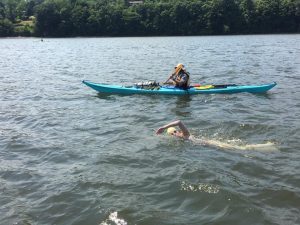
The kayak escort ensures the safety of each swimmer and also, organizes the feed bottles so that feeds are given to the swimmer every half hour. Because of this, the kayaker is a central figure to the team. Some pairings of kayaker and swimmer bond to the extent they work together for swims across the USA and beyond. In other cases, swimmers will recommend their kayaker to another swimmer taking on the event the next year.

As we reached the halfway point of the stage, the chop kicked up slightly. It was enough to swamp the kayaker for the lead swimmer. This called for a swift rescue from David Barra’s Agent Orange rescue boat. The kayaker and kayak were retrieved, ferried to the main Launch 5, and the swamped kayak exchanged for a fresh one, not forgetting to transfer the swimmer’s feed bottles. The swimmer was Stephen Rouch of the USA who was way out in front, setting an amazing pace, but perhaps a bit disconcerted at his kayakers’ disappearance. Launch 5 kept pace with him until his escort could be restored.

Shortly after this, the lead passed to Graco Morlan of Mexico but he was overtaken in the last two miles by Rouch who was the first to pass under the Kingston-Rhinecliff bridge. Morlan was a close second, with Flavio Toi of Brazil coming in third. Abby Fairman  (USA) and Marta Izo (Brazil) came in next, followed by Ed Riley (USA).

Some swimmers do well in turbulent conditions, and apparently Graco Morlan is one of them. “He just loves the chop” yelled his kayaker as Morlan powered past. He and Rouch seemed to be racing head to head. Tomorrow will tell if this has depleted their energies. 8 Bridges, is, after all, a phenomenal test of powers of recovery.

A Love Affair

By Janine Serell

I’m a romantic about swimming, anyone who knows me knows that the Hudson is my favorite water to swim in.   Earlier this week there was a blog about the people who make this event special which we all do in so many different ways, but I think the river is really the star of the show.  The Hudson is the pin-up of rivers; she’s fast and sexy, moody and angry and goes from glass to white caps in the blink of an eye.  I’ve been lucky enough to travel a bit in life and so often when i see one of the ‘great’ rivers of the world i’ve been a tad disappointed, they have all lacked the grandeur of the Hudson.  This is a river that inspired an entire school of painters who were so blown away by her beauty that they sought to immortalize it and share it with those not fortunate enough to visit her, and we get to swim, paddle, cruise and frolic in her, lucky us!

On the practical side the river supports commerce as we swim in her.  There’s something so cool about swimming with giant barges gliding by.  When you volunteer you get to hear the astonishment of the boat captains as someone explains that there’s 19 swimmers in the river going down the west side some of who will swim 120 miles over the course of a week, and if you’re lucky  they’ll even toot their horns in celebration when they see you.   Long freight trains and short passenger  trains snake along the river banks passing you as you swim.  I loved when i lived in the city taking the train to the start of a stage….the early morning sun shining on this bucolic setting would always put me in the right frame of mind to enjoy the river.  She’s not something to be conquered, but rather to be respected and enjoyed.  You can swim with her and in her, but not at her, she will not be bullied.  You need to find her rhythm that morning and match your breath to her’s.
This is my home water, the place i feel the most comfortable swimming.  I swam my 1st mile here in 2010 and have been lucky enough to jump in every year since.  I’m swimming the stages of 8 Bridges easiest to hardest as I’m optimistic that i will continue to improve that little bit I need to make the next bridge each year.    But no matter how my day in the river ends whether beyond the bridge or in a rib I will be eternally grateful that I got to jump in and swim happy in the Hudson again this year.   XOXO

The time has come

By Devon Clifford

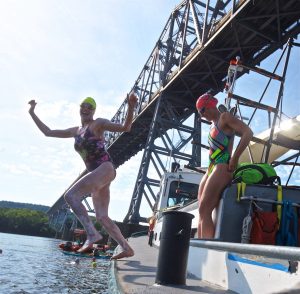
The time has come. It’s that time of year again when a group of proclaimed “crazies” strip down to their swim suits, lather up with sticky white pastes of zinc, and press their goggles tightly into their eye sockets as they prepare to take the infamous jump off the bow of Launch 5 and begin their journey down the mighty Hudson River. As the years have gone by, I have fallen more and more in love with 8 Bridges; the people, the guidance, the connectedness to one of nature’s most beautiful elements, and the bridges.

I remember my nerves the first time I jumped in the river to ride the push in Stage 3. It’s a beautiful stage, and the shortest of the week totaling just about 13 miles, so for me at the time it was a perfect starting point. I remember wearing a flamingo printed swim suit as I swam with my father guiding me in his kayak at my side. The water temperature was perfect, I’m sure (at least that’s how I remember it because that is what Kent – SCAR race director – has instilled in my brain as the temperature always, no matter location, time of year, or weather conditions… it is always “perfect!”). I didn’t know enough about nutrition in distance events at the time so I only fed on water and Gatorade, and I probably didn’t get enough sleep that week because I had friends in town from Ireland. None of that mattered in the end though because as much as it was a learning experience, swimming stage 3, albeit slightly under prepared, was one of my first stepping stones into teaching me gratitude for a sport that has become my world.

In the years since my first stage swim of 8 Bridges, I’ve experienced and accomplished swims all over the world but June in the Hudson is by far one of my favorite times and places. I’ve come back to be a part of this event every year since that first stage and hope to be a part of the event for as many years to come as possible. I’ve participated as a swimmer doing one or two bridges, as well as striving for the whole chalupa (is that what Dave was calling 8B for the 7 stagers last year??) and I’ve come back as a volunteer, too. To be a part of 8 Bridges is not just to swim, but to be a part of a family. It truly is a magical time when you allow yourself to embrace not just your swim but the experience of others’ swims, as well. There is so much excitement, so many nerves, so much spirit, and so much love.

You’ll hear constant chatter though out the week about the water temperature (which, like I mentioned, is always “perfect” according to Kent – you’ll want to remember this and maybe allow it to become your mantra) and about things you feel or felt along the way, about the weather, about who is swimming what day, etc. “What is the temperature this morning?” “Do you think it will warm up?” “How are you getting back in the water day in and day out?” My favorite bits of chatter, though… that would be the positivity and the way we lift one another up for what we are about to or have accomplished. There is a spirit you’ll encounter during the week that may be unlike any you’ve been a part of before – a support system more giving than any I’ve experienced outside of swimming. This is after all, as far as I know, the most team oriented solo sport around!

The positivity doesn’t just come from one swimmer congratulating another, it comes from the non-swimmer perspectives as well. It starts at the top as Rondi and Dave have created this glorious river swim for us and you can tell how much they care without words even being a part of the equation. If you pay close attention, their actions will comfort you more than warm water and a sunny day. The passionate guidance from Greg and his crew as he guides us all on Launch 5 goes just the same. Let’s be honest though, what fun would swimming down a river be if you didn’t have someone with whom to share the experience? This is where the positivity of kayak support comes into play. Personally, I know I am the luckiest swimmer in the water when I have Lizzy by my side guiding my way, supporting my needs, and cheering me on… sorry, everyone else! Lizzy, you’re the best.

The emotions and banter all come together and nothing is better than finishing the end of each day with a smile, so don’t forget to bring that with you. As you approach the bridge (don’t sight too soon or that bridge may feel forever away for a very long time) at the end of your first and maybe only stage, or your second, third, fourth, fifth, sixth, or final stage just remember to enjoy what you’ve just accomplished. Turn over onto your back and take a minute to look up at the beautiful structure you just swam to, and appreciate where you started. We will all have a different experience despite sharing the same water, and somethings may be harder or easier for you during that stage, but the smiles at the end are the best part. Stay strong, swim smart, and enjoy yourself. Don’t get too upset if things don’t go exactly as planned though because no matter what you do in this river, you’ll only be as good as the Mighty Hudson allows!

See you in the water soon. Swim happy, my friends!

How do swimmers train and prepare for 8 Bridges?

By Liz Morrish

The 8 Bridges Hudson River Swim is certainly an event for the experienced marathon swimmer. I was curious about what level of preparation and training the participants were undertaking. I received some very detailed training diaries which gave me a picture of just what it takes to approach a very testing swim series like this. Remember, some swimmers are entering all stages of the swim, others are swimming one, two or three stages.

The average training distance seems to be 30,000-40,000 meters per week. A lead-in of 12-15 weeks seemed usual, with distance gradually increasing from 3-6k per day. On the longer side was 50,000 meters per week for 12 weeks, including an 8 or 9 miler on the weekends. Another swimmer is reaching 45,000 meters per week and will build up to 60,000. A week of 100km in end of April will be part of this individual’s preparation. In the pool, there will be interval training as well as long training swims of up to 5 hours before the event. The experienced swimmer will also focus on technique and efficiency as well as speed and endurance.

While working out 3-4 times a week in a pool, some prefer to swim alone, others enjoy the company and support of doing masters workouts. Surprisingly few swimmers mention coaching as part of their preparation. This was typical “I swim 2 days a week on a Masters team and 2 days a week on my own to train for this event.”

Actual open water preparation has largely been dependent on geographical location. Not everyone is as fortunate as this person, “I swim around 5K every morning with the Bearcat Masters of New York, and I take part in a 10K race every month in the Caribbean.” One swimmer in Massachusetts was itching to get back into open water, but in April it was still in the 40s F (4.5-9.5C). Others alluded to more improvised solutions such as cold showers and baths to aid acclimatisation.

As well as spending long hours in the water, most swimmers will turn to other forms of exercise – cross training is a common feature of preparation. Alongside 3-4 days per week swimming, we see incorporation of roller skiing, running, cycling/spinning, yoga and of course weights into training regimes. Some will have injuries to rehabilitate: “cross training: running, biking, weight training for shoulders to increase stability and avoid injury.” Only one respondent mentioned taking regular advice from a nutritionist.

In terms of previous marathon swims, the SCAR events in Arizona have been a popular foundation for 8 Bridges. http://www.scarswim.com/ These are a series of four, consecutive-day, ‘visually spectacular’ lake swims of between 9-17 miles. However, many of the participants are also veterans of the English Channel, the Catalina Channel, Key West and several other classic long-distance swims.

Due to the tidal nature of the Hudson, each of the 8 Bridges stages demands an early splash time. The early starts will not hinder this enthusiast: “Swim many hours on the weekends. Get up at 4am to swim 2 hours before work 2 days/week, swim less on some other days”.

Although it is more of an individual challenge than a competition, this swimmer has thrown down the gauntlet and has huge expectations of themselves and the experience: “Well, first of all, I’ve been studying the competition. I think knowing the rules and the place can really help me to prepare physically myself. And then I’m picturing the whole thing so I can prepare myself mentally. Testing my limits and knowing my boundaries through the process can make me not only a better swimmer but a better person in this challenge and every other one”. Another view sees this, not as a new and exceptional departure, but almost as a lifetime’s project “I believe your preparation/training starts with your 1st swim lesson when you were a toddler and, in the course of the 7 days, you will call upon each and every day of those many years of training to successfully complete all 7 stages”. Both of these visions are equally valid, and the swimmers will all encounter new and unpredictable challenges and draw on old, practised resources. The week will provide some compelling stories which I, and the swimmers, will be documenting on this blog.


Introducing the 2017 8 Bridges Swimmers

Liz Morrish

We are in the last few weeks of preparation for the swimmers taking part in the 2017 8 Bridges Hudson River Swim. 27 participants responded to a questionnaire, so here is a brief introduction to some of those who are doing multiple stages of the swim.  I hope to introduce the others during the week of the swim. I will also be asking them questions about training, nutrition and staying motivated for this marathon event. As you will see, they are an experienced and well-prepared group of swimmers.

Doing each stage of the swim:

Abby Fairman is 40 and from Turbotville, PA. She works as a marketing director. Previous marathon swims include 8 Bridges Stage 6 (2016, 2015), Catalina Channel (2016) and Manhattan Island Marathon Swim (MIMS) (2014).

Harry Finger is 59 and from São Paulo, Brazil. He is an architect, and also owns a soup shop! He has completed an English Channel swim and the 14 Bis in Brazil. The 8 Bridges has given him motivation to continue marathon swimming after knee surgery in 2016.

Marta Mitsui Izo is 47 and from São Paulo, Brazil where she works as a swim teacher. She already has an English Channel swim under her belt, as well as taking part in a Channel Relay England-France-England relay in world-record time.

Edward Riley is 58 and from New York, NY. He has already completed several stages of the 8 Bridges in previous years. What keeps him coming back to 8 Bridges? “It’s the gold standard for marathon swimming. It not only measures your endurance but also speed and uniquely your recovery”.

Flávio Toi is 51 and from Campinas, Brazil where he works as an electrical engineer. He has completed the swim round Key West and also the 40km Tietê river In Brazil. He will be accompanied by his wife and 12 year old son.

Jamie Tout is 64 and from Austin, Texas. He is a retired revenue agent for IRS. Previously completed swims include the English Channel, Catalina Channel, MIMS, Saguro Lake and Canyon Lake of SCAR 2016, and various stages of 8 Bridges. He has also run marathons and completed the Hawaiian Ironman Triathlon in 1981, the same year as his English Channel swim.

Katrin Walter is 39, originally from Germany but now living in Buttikon, Switzerland, where she is a project manager in the financial industries. She has already completed the Lake Zurich Marathon Swim, the 2015 Tampa Bay swim and the Swim around Key West. Her partner will be accompanying her on the 8 Bridges.

Swimming three stages:

Ali Hall is 55 and from San Francisco, CA. She is a trainer and behavior change consultant for helping professionals in life coaching and health coaching. She is a seasoned marathon swimmer, having competed in various locations across the USA. She has had a serious spinal injury, so swimming in the 8 Bridges stages 1, 3 and 4 will definitely be a challenge.

Spencer Schneider is 57 and from New York, NY. He is a lawyer who has completed Sections of 8 Bridges, 20 Bridges and Around Montauk swims. This year he is swimming stages 1, 3 and 5. He is also a triathlete and trail runner.

Swimming two stages:

Erica Flickinger is 38 and lives in Phoenixville, PA where she is an office manager for the Healing Arts Center. This year she is doing stages 2 and 3, and hopes to complete all the stages, in turn, in the future. She has completed two SCAR swims and is now looking forward to a challenge. She will be accompanied by her boyfriend who will be kayaking for her.

Joshua Gordon is 21. He was born in Welwyn, UK but now lives in Phoenixville, PA where he works as a swim instructor. He has previously completed swims around Key West, and the Kingdom 15 mile Border Buster. He is doing stages 4 and 7, and is aiming to gain experience for an attempt at the English Channel.

Stephen Rouch is 36 and from Indianapolis, IN. He is a software developer. Stephen is registered for stages 2 and 3. Since he went to college in Poughkeepsie, he is keen to start and finish there.  He has previously been a SCAR participant.

Eric Schall is 56 and from Kingston, PA where he manages a Ready Mixed Concrete company.  He is coached by Mary Stabinsky (below). He has previously done a number of 10k and 10 mile swims including Lake George, the Potomac River Swim and the Lake Memphemagog 10 Mile. Swimming stages 1 and 5 of 8 Bridges will be a way of stepping up towards his planned 20 Bridges swim round Manhattan in August 2017.

Mary Stabinsky is 40 and from Plains, GA where she is a Financial Analyst/Internal Auditor for an AutoMall. Together with Eric Schall, she is swimming stages 1 and 5 in preparation for a 20 Bridges attempt in August 2017. Mary has previously completed Lake George 10k and Spuyten Duyvil 10k swims.

Mark Spratt is 61 and from Indianapolis, IN where he is a Controller for the Indiana Department of Corrections. He has completed several marathon swims including MIMS, Catalina Channel and SCAR. His most memorable swim, though was the 2013 Ederle Swim, in particular swimming under the Verrazano Narrows Bridge. Mark is swimming stages 3 and 4, having swum stage 6 last year. His goal is to do all 7 stages over time.

Paula Yankauskas is 62 and from Hyde Park, Vermont. She is a veterinarian who is a seasoned marathon swimmer with an English Channel swim and a Lake Champlain swim under her belt, as well as many others. She is swimming stages 3 and 4.

Why Do I Swim Today?

NOTE: The following is a post written by Charles Bender before his Stage 3 swim on June 20, 2014. Charles passed away on March 6, 2017, and will be sorely missed by the open water and triathlon communities.

This morning I will enter the Hudson River in Poughkeepsie, New York with 9 other swimmers attempting to swim 13.2 miles (as the crow flies, not the swimmer swims) to Beacon, New York. It’s part of  8 Bridges Hudson River Swim, which is an eight day, seven stage swim totalling 120 miles from the Catskills to New York Harbor. It’s put on by the Coney Island Brighton Beach Open Water Swimmers (CIBBOWS) and is in it’s 4th year.

In addition to being a marathon open water swim event, it is also designed to raise funds and awareness for Riverkeepers Hudson River Water Quality Testing Program (no we are not human test tubes) and Launch 5 Hudson River Environmental and Safety Foundation.  So I’m privileged to be doing something super challenging and for two great causes.

People often joke about my needing shots and ask if I’m worried about pollution, pcb’s etc. “Of course I’m worried about pollution and pcb’s” I tell them; “shouldn’t we expect to be able to swim in our rivers, streams, lakes and oceans without worrying about our health?” After all, these waters are what truly sustain us and all life on our planet.

But why me today?

I’m an “athlete”, sure in the sense that many of my 50 something year old friends are “athletes.” Fifty may be the new 40, but to race directors and organizers of every sport across america, it’s like a 0% interest loan from the Federal Reserve; guaranteed money in the bank. A 40 something captured the spirit perfectly several weeks ago as we were cycling in the Black Bear Triathlon; “So this is what you decided to do to celebrate turning 50?” He was able to make this slightly snide remark because I had my age marked on my right calf, part of the triathlon race rituals, my own scarlet letter screaming to all who I was and what I was about.

But swimming, especially marathon open water swimming, is a small, almost hidden corner of the athletic universe. No waiting for lottery results to see if you and 39,999 of your closest friends will get the privilege to run the <Insert your favorite city here> marathon. So this has the cachet of being a small, unique event and a real head scratcher to most folks you tell you’re attempting

I swam Tuesday night with a local group of mostly triathletes, in the Schuylkill River just north of Philadelphia. A number of my companions were fantastically fit 20 and 30 year old athletes who think nothing of training for a 140.6 mile Ironman race. But tell them you’re about to embark on a 13 mile swim and they step back and get dizzy telling you how nuts that sounds (sort of like the Group W bench in Arlo Guthrie’s Alice’s Restaurant.) So being able to stop an amazing athlete in their tracks as they praise you for  being some sort of superhuman freak of nature is pretty sweet.

But that isn’t really it either.

I’m a broken human being. Full of flaws, I’ve done a lot of things I’m not proud of. For the last 13 months I’ve dealt with that head on. That makes me just human, I know, but we all experience our broken selves as a singularity; a lone, isolated event with a unique sense of isolation and despair.

Turns out, like dirty rivers, we can be healed, even a knucklehead like me. It just requires a little perspective, and practice and learning to sometimes, just live in the moment. I often mocked this type of bumper sticker philosophy (very common in my sometimes crunchy granola neighborhood of Mt Airy). How could I possibly live in the moment, and ignore “the facts” of my own life?

Being broke down, sick and tired and a little desperate turns out to be powerful medicine. It humbled me and opened up my mind, slowly, when I allowed it, to give me some perspective.

Perspective like this…

Earthrise from the surface of the moon

The pale blue dot

“Look again at that dot. That’s here. That’s home. That’s us. On it everyone you love, everyone you know, everyone you ever heard of, every human being who ever was, lived out their lives. The aggregate of our joy and suffering, thousands of confident religions, ideologies, and economic doctrines, every hunter and forager, every hero and coward, every creator and destroyer of civilization, every king and peasant, every young couple in love, every mother and father, hopeful child, inventor and explorer, every teacher of morals, every corrupt politician, every “superstar,” every “supreme leader,” every saint and sinner in the history of our species lived there – on a mote of dust suspended in a sunbeam.

“The Earth is a very small stage in a vast cosmic arena. Think of the rivers of blood spilled by all those generals and emperors, so that, in glory and triumph, they could become the momentary masters of a fraction of a dot. Think of the endless cruelties visited by the inhabitants of one corner of this pixel on the scarcely distinguishable inhabitants of some other corner, how frequent their misunderstandings, how eager they are to kill one another, how fervent their hatreds.

“Our posturings, our imagined self-importance, the delusion that we have some privileged position in the Universe, are challenged by this point of pale light. Our planet is a lonely speck in the great enveloping cosmic dark. In our obscurity, in all this vastness, there is no hint that help will come from elsewhere to save us from ourselves.”

– Carl Sagan, Cosmos

Swimming in open water gives you fantastic perspective. You’re immediately small and not fully in command at the beach, on a lakeshore or a riverbank.

My earliest swimming memories are from Harvey’s Lake, Pennsylvania, where my grandparents had a summer home. I learned to swim in that lake at Sandy Bottom beach (now some fancy private facility) and on the dock of my grandparents second summer house. I loved swimming from that dock. Down the steep hill from the house to the road, and down some more to the lake and dock house I’d run every morning. At the end of the dock, the lake opened up to what seemed like another world on the other side (even though I had driven around and past that spot many times.) It was probably less than a mile, but it seemed like a much greater distance.

It would always take me a few days to get comfortable swimming in the lake. The water changed temperatures it seemed for no reason. It was clear to about 8 feet nearest the dock, but then dark and scary. There were living, breathing things in the water, which sometimes touched your feet and legs and gave me a jolt of fear. But slowly I’d find myself in the water. Each day I could venture a little further out, until my Grandmother, Aunts and Uncles would yell to me that I had gone too far, to be careful. That was the sweet spot, the special place looking back at their miniaturized figures on the dock, voices echoing on the water.

I swam a lot after that and then I stopped. Some of those swims in between were in open water, rivers, lakes and streams and were just for fun. But swimming became a sport and was done mostly in a 25 yard pool with crystal clear water. I loved being a part of my swim club, high school and college teams. The camaraderie was great, even when the work was hard and frequently tedious. But at 21, I found other interest and pursuits that consumed me. Post college life became very hectic.  I tried to swim, but found that every time I went to the pool, I hated it. I had no imagination and all I thought possible was chasing a black line on the bottom for exercise. Nothing spiritual, nothing fun, just the tedium of the pool and clock. So I stopped even trying.
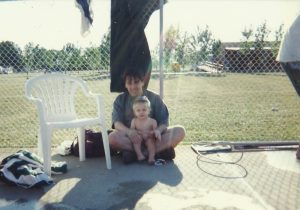

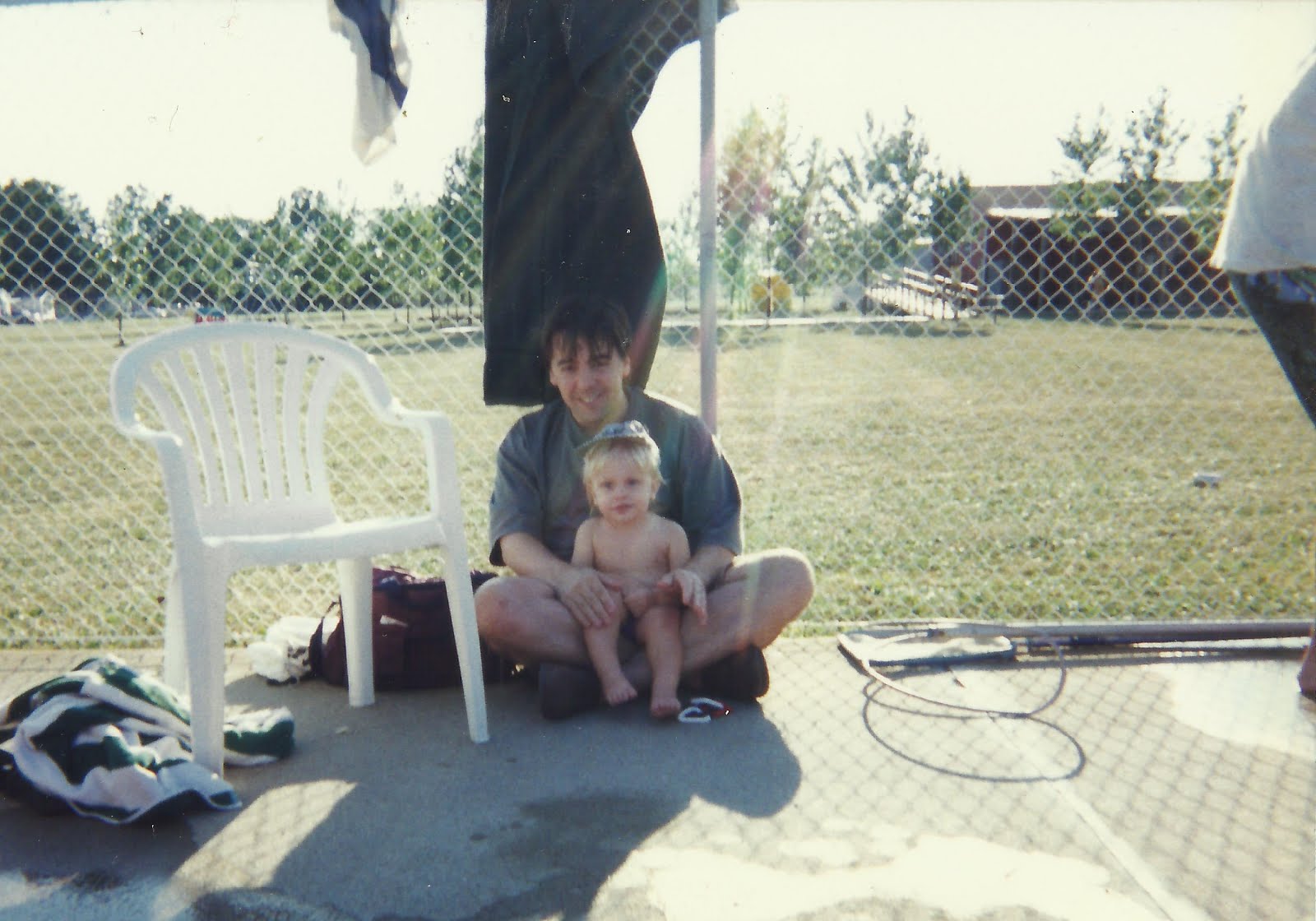
Matt and me, summer 1999, campground S. Ontario
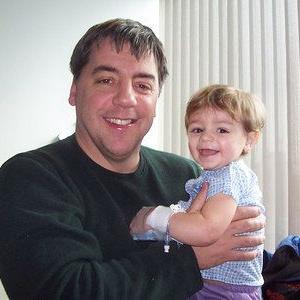
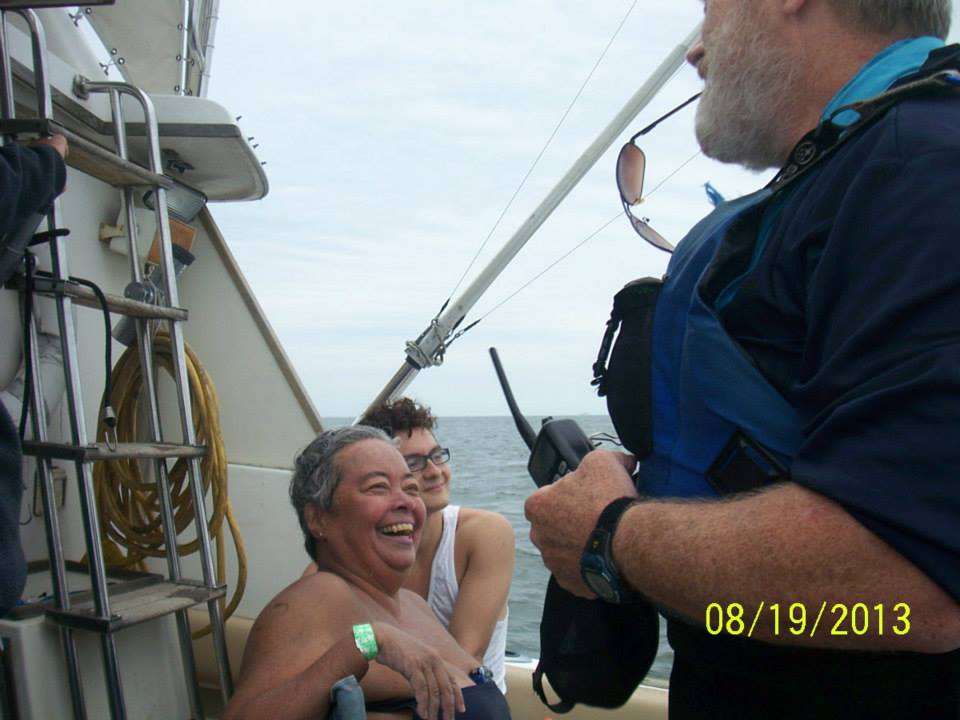
Carlos and me, Children’s Hospital Philadelphia, Feb 2006

A funny thing happened. I had kids, who turns out, didn’t see the pool as an endless black line, heavy breathing and a clock. It  was just a place to cool off, be held by their Dad and to test their boundaries. It was just another place to have fun and feel loved….with me!

I love the picture with Matt in my lap at a campground pool in southern Ontario. Now I would be the one sitting in his lap, his 6’1 frame easily surrounding me. He never got bit with the swimming as sport bug (football and baseball are his thing) and he won’t give Phelps or me much competition in the pool. But you know what, he still knows how to splash, play and have fun in the water.

Carlos is more of a water bug but not wired to be a competitive athlete. But Wednesday afternoon, there we were together playing catch and tag in the pool. And me deliciously holding his 9 year old frame close, walking and whispering together in the water, like we did those 2 long weeks when he was in the hospital as a young boy. So my kids taught me I could have fun in the water again.

I’ll set off today, blessed with a number of tools, that swimming laps can never provide. The first is a child’s love for the water, especially the open water of a lake or a river with it’s distant shore in sight, but maybe just out of reach..?

I’ll be blessed to know I’m just a small, slow, dot on the surface of a mighty river. And I’ll be connected to all that lives and breathes and draws life from it’s waters, so I won’t be inconsequential. Not fully in control, but not insignificant or meaningless either.

I can’t fail either, because I began the journey.
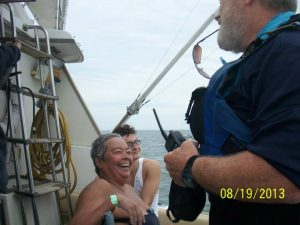
Capri Djatiasmoro, Ederle Swim 2013

That’s Capri Djatiasmoro, a veteran and real champion of open water swimming. I met her accidentally, when I was assigned as her “Observer” last summer at the Ederle Swim. She didn’t quite get to the beach at Sandy Hook that day. She was the first swimmer in the water and I believe the last swimmer out and had a magnificent swim. She had a great kayaker who knew the waters, tides and currents on the voyage that day. The last few hours I was almost frantic; “What do we need to do to help her get on the beach?” And when it was all done, and the decision had been made by her, to end the swim, I looked over and saw her and was stunned. She was happy, relaxed and smiling.

I’m glad I snapped that picture because it offers just as much perspective as those amazing NASA pictures from the moon or Voyager 1. Seeing her laughing brought a calm to me. She had a great swim and knew it. We had all worked as hard as we could to help her to the beach, but it didn’t happen. Oh well, that’s life. Was I really so arrogant that I thought that 7 little dots and 2 very small boats were in charge on the waters of New York Harbor? There was so much that none of us would ever be able to control, most especially the shifting tides and sea bottom, that itself had been shifted and sorted by a superstorm the fall before.

That day on the boat helped me continue to heal, feel less broken, and be more connected. Connected to my loved ones, especially those two boys who showed me how to just splash and play again in the water. Connected to a vast, unknowable universe and some of the people and places in between.

My training hasn’t been conventional or a straight line but I’m plenty fit and strong; stronger in fact than I have been in many years, maybe ever. My shoulder sometimes aches and I had to rush order a new suit and goggles because of course I lost my other new pair last week. But I am learning how to get my mind and spirit in the right place to take an adventure like this. I’ll pause along the way and accept and welcome the fact that the river and wind and spirits are more in control than me. I’ll be thankful for the many volunteers who labored over the logistics and  details to make this even possible. And I’ll smile a lot, especially when I get out of the water, wherever and whenever, because no matter what, I’ll have had a great swim.

“It’s only 13 miles….

Post script

I finished the swim in 5 hours and 15 minutes; 10th out of all 10 swimmers. Thru Day 3 everyone has finished which is fantastic. And being the last swimmer means you have the entire crew of swimmers, kayakers and volunteers to cheer you across the final yards. It was spectacular.


Online Casino Guide: How to Register, Claim Bonuses, and Play on Mobile

Many players have questions about Spin Boss before they deposit their first euro — here are the honest answers. This comprehensive guide walks you through every step, from setting up your account to claiming bonuses and playing on mobile. You’ll also learn how to stay in control with responsible gambling tools.

Getting Ready

Before you start, make sure you have everything you need:

  • A stable internet connection — 4G or faster works best for mobile play.
  • A modern browser (Chrome, Safari, Firefox) or the progressive web app (PWA) which you can add to your home screen from the browser menu.
  • A valid email address and a copy of your ID or passport for verification.
  • A payment method you plan to use — credit/debit card, e-wallet, or bank transfer.

Account Setup

Follow these steps to create and verify your account:

  1. Visit the site and click ‘Sign Up’. Enter your email, create a strong password, and fill in your personal details.
  2. Check your email for a verification link and click it to activate your account.
  3. Complete the Know Your Customer (KYC) process by uploading a photo of your ID and a recent utility bill. This is mandatory for withdrawals.
  4. Log in, navigate to the cashier, and choose your preferred payment method. Make your first deposit — the minimum is usually €10.

Playing on Mobile

The casino is fully optimized for mobile browsers and also offers a progressive web app (PWA). No separate app download is needed from app stores. Simply open the site in your browser, add it to your home screen, and it will launch like a native app. All games, bonuses, and banking options are available on the go.

Bonus & Promotions

New players can typically claim a welcome bonus package. For example, a 100% match bonus up to €200 on your first deposit. Here’s how the math works:

Important: Always check the bonus terms — wagering requirements, game contributions, and expiry dates vary.

Example: You deposit €100 and receive a €100 bonus. The wagering requirement is 30x the bonus amount. Total amount to wager: €100 × 30 = €3,000. You must play through €3,000 before any winnings from the bonus can be withdrawn. If you play slots (which usually contribute 100% to wagering), each €1 bet counts fully. After meeting the requirement, any remaining bonus funds become real cash.

Need to Know

What is the minimum deposit?

The minimum deposit for most payment methods is €10. Some e-wallets may have a higher minimum.

How long do withdrawals take?

Processing times vary by method. Below is a typical timeline:

Method Processing Time Minimum Withdrawal
E-wallets (e.g., Skrill, Neteller) 24–48 hours €20
Credit/Debit Cards 3–5 business days €20
Bank Transfer 3–7 business days €50

Are there any country restrictions?

Yes, some countries are restricted. Check the terms and conditions for the full list. Also note that the casino operates under a Curacao license. For players in EU or Nordic countries, winnings may be subject to local income tax. Consult a tax advisor if unsure.

Can I set betting limits?

Absolutely. You can set deposit, loss, and wager limits from your account settings. More on that in the next section.

Extra Tips

Responsible gambling tools are available to help you stay in control:

  • Deposit limits: Set daily, weekly, or monthly deposit caps.
  • Session limits: Receive reminders or be automatically logged out after a set time.
  • Self-exclusion: Choose a cooling-off period (24 hours to 6 weeks) or a permanent self-exclusion if needed.

These tools can be activated from your account settings. If you ever feel you need more support, contact customer service or visit responsible gambling resources like GamCare.

Now you have everything you need to start your gaming journey. Remember to read the terms and play responsibly. Good luck!

Verde Casino: Strategie Vincenti per Massimizzare il Divertimento e i Guadagni

Giocare online offre una varietà di esperienze uniche, e Verde Casino it è uno dei nomi più rispettati nel mondo dei casinò online. Non si tratta solo di un sito dove scommettere, ma di un vero e proprio universo di divertimento e opportunità. In questo articolo, esploreremo le strategie più efficaci per massimizzare sia il vostro divertimento che i vostri guadagni su Verde Casino.

Scegliere i Giochi Giusti

Una delle prime mosse cruciali per avere successo su VerdeCasino è la selezione del gioco. Ogni gioco ha meccaniche e probabilità diverse, ed è importante scegliere quelli che meglio si adattano alle proprie abilità e preferenze. Ad esempio, le slot machine offrono un’esperienza di gioco basata principalmente sulla fortuna, mentre giochi come il blackjack possono richiedere strategia e competenza. È sempre una buona idea iniziare con giochi che offrono un tasso di ritorno al giocatore (RTP) elevato.

Gestire il Budget con Intelligenza

La gestione del budget è una componente essenziale per un’esperienza di gioco positiva e sostenibile. Stabilire un budget di gioco e rispettarlo è cruciale. Iniziate fissando un limite massimo che siete disposti a spendere e considerate di suddividere il vostro budget in sessioni più piccole. Questo vi permetterà di giocare più a lungo e aumentare le possibilità di vincere nel tempo, senza compromettere la vostra stabilità economica.

Sfruttare i Bonus e le Promozioni

Verde Casino offre una varietà di bonus e promozioni che possono essere sfruttati per aumentare il saldo del vostro conto o ottenere spin gratuiti. Queste offerte possono essere particolarmente vantaggiose per i nuovi giocatori, ma anche per quelli abituali. Leggete sempre i termini e le condizioni per assicurarvi di comprendere appieno i requisiti di scommessa associati a ciascun bonus.

Prendere Pausa e Giocare con Moderazione

È facile lasciarsi trasportare dal momento quando si gioca online. Tuttavia, è importante sapere quando fermarsi. Prendersi pause regolari aiuta a mantenere la concentrazione e a prendere decisioni più ponderate. Ricordate sempre che il gioco deve essere un’attività divertente e rilassante, non una fonte di stress.

Usare le Opzioni di Gioco Responsabile

Verde Casino prende sul serio il gioco responsabile, offrendo una serie di strumenti per proteggere i giocatori. Tra queste, ci sono la possibilità di impostare limiti di deposito, autoesclusione e timeout temporanei. Utilizzare questi strumenti vi aiuterà a mantenere il controllo sulle vostre abitudini di gioco.

Conclusioni

Giocare su VerdeCasino è un’esperienza che combina intrattenimento ed emozione con l’opportunità di vincere. Seguendo queste strategie, potrete aumentare le vostre probabilità di successo e garantire che il vostro tempo sul sito sia sia sicuro che gratificante. Non importa quale tipo di giocatore siate, ricordate che il divertimento è sempre l’elemento chiave. Buona fortuna e buon divertimento nel mondo di Verde Casino!

Verde Casino Logo

First Swim, 1st Stage – Rip Van Winkle Br. to Kingston Rhinecliff Br.

Exactly a month ago I was stroking and kicking through my first ever marathon swim. I swam a whopping 18.3 miles, more than double the distance I’ve ever swum at once.

Somehow I never get to train properly for my races. Not because I can’t get serious about the training but there is just always something in the way – an injury, crazy workload (same reason I didn’t get to sit down and write this right after my swim – a month ago); limited time, money or both. 8 Bridges was no exception even though I did get to squeeze in 3 2-milers and a bunch of 20-60 min training swims. I was more prepared than for any other races I have ever done, but would it be enough to take me through 18.3-mile swim?

I picked Stage 1 for all the wrong reasons – not because of the distance and my previous experience, but because I had friends living ‘just’ an hour drive away from the starting point so I could have a place to stay. I practiced my nutrition in a 1-hour swim trying to chug down a quarter of a 20 oz bottle, not a 4-hour swim with feeds like David Barra recommended.

But here is a good and bad thing about open water swims – ready or not, but the daycomes when you better take your clothes off and jump in the water and do the best you can. And so I did, we all did. Some swimmers starting their 7-day journey down to Verrazao Bridge, some, like me, doing their longest ever race; all determined and ready to push our limits.
Jump in, fix your goggles, find the turquoise kayak. 10,9,8,7… GO!!!

8Bridges start

The next 30 minutes I was debating with myself if I should stop and tell Luis that I want him slightly behind, not in front of me – before this swim I never knew where I prefer my kayak to be. Now I know. I wouldn’t have to pick my head up to check where the boat is if I don’t see it when I breathe, but I could also see what the paddler is doing, see his face and expressions every time I turn. There was nothing bad in stopping for 30 seconds to communicate that to him.

For the first couple of miles I was enjoying seaweed all around me. I would pick it up with my fingers and try to play with, laughing (bubbling) when it would get on my head or stuck on my nose. There was so much seaweed!
I was trying to tell myself jokes but somehow I could barely remember any. I would definitely need to read more jokes before next race. I was trying to do math in my head but there was not much to do – I counted how long I would be swimming by the time I finish my first feed – 2.5 hours; second – 4.5; third – I didn’t want to think beyond that point. The stage record was 4 hours 30 minutes, I knew it would take longer for me but a girl can hope, right?

First feed came, another one, some more – first bottle done. I mixed something different into the second one. Oh how yummy it was!!! Never knew I would be drooling over my feed in the middle of the Hudson! Worth to pick up the pace until the next feed, like if it would come sooner if I swam faster… ☺

My left shoulder started hurting after the 1/3 of the distance. I hoped it’s just soreness and not an old injury and miraculously it stopped aching after another two hours of swimming. My shoulder probably knew I need it for a little longer.

I tried to look around as much as I could, saw some trees and houses on the shore. A lighthouse, other swimmers and kayakers passing by. I had wished I could be in a kayak or one of the support boats so I can see all the beauty of this swim. I would try to enjoy every stroke and the view coming with it for a bit and than I would put my mind back in the water, pick up the pace and just swim trying to get the Kingston Rhinecliff bridge to come sooner.

8bridges - swim

I knew from reading past blog posts that me seeing the bridge didn’t mean I’m close. But when Luis told me we are 2/3 way there I asked myself ‘What??!?!!’ I knew it was too good to be true but I couldn’t hide my excitement. Of course the current wouldn’t allow it to be that easy. Only after another 2-3 hours of swimming, dealing with back pain (was good to learn later that it is normal to experience pain in a lower back on longer swims) I got in the shade of the bridge, swam all the way to the south end of it and rolled into a ball to stretch my back. How good that felt, finally!

When I was signing up for this race I had no idea how much it is going to mean to me. The burning feeling inside, the sense of accomplishment – it feels like the door opened into something wonderful and new. As if I was able to do this is there really something I can’t do?!?? Swimming the last mile, I thought, “Why do I do this in the first place? It’s hard, painful sometimes and it takes so much time out of our precious lives. Why can’t I be like my friends spending all day in front of the screen and playing video games instead?” A couple of days later, after all the feelings settled down I knew the answer. Because without water, without what I do, I wouldn’t be fully living.

Huge THANK YOU to Rondi, David and the rest of the 8Bridges crew, you did terrific job organizing this event, and I really hope you’ll do many many more!
Thank you to my amazing kayaker Luis for handing me feeds, water and keeping my spirits high. I don’t know if you saw me smiling while I was swimming but here and there, for a great part of the distance, I was 🙂
Thank you to my amazing boyfriend for always supporting me no matter what kind of crazy things I do.
Thank you to all my swimming students for your stories, inspiration and helping me to make this happen.
It was my first real marathon swim and I know there will be many more to come.