Stage four was a “two for one” special. It was like doing two completely different swims on the same day on the same river!
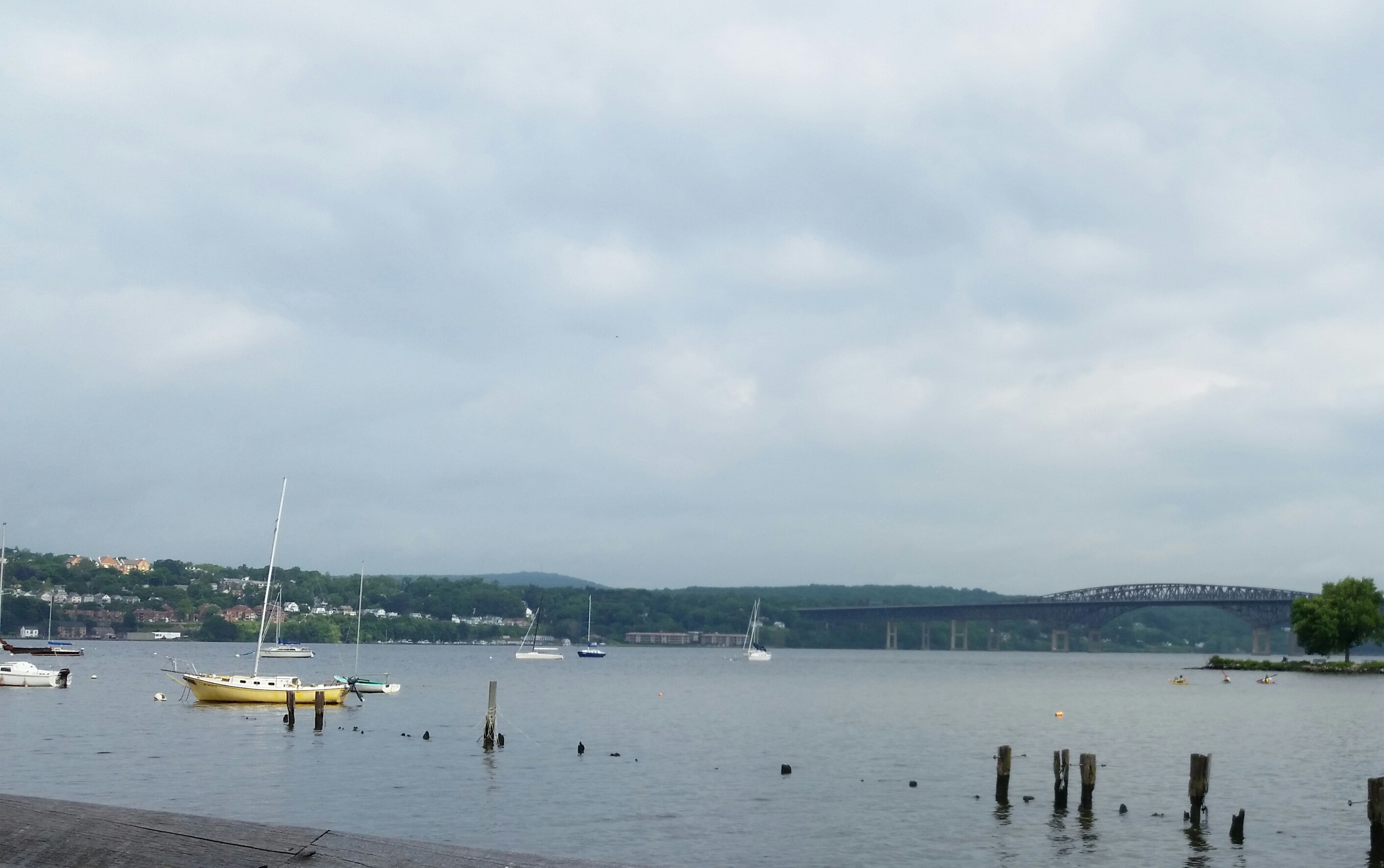
We jumped at exactly 10AM to begin the trek from the Beacon-Newburgh bridge to the Bear Mountain Bridge. The distance was 15.2 miles. The first five miles was a straight shot down a wide section of the river. For about an hour I had the same song stuck in my head, but at the finish I couldn’t even remember what it was! The middle section of the swim wound its way toward the West Point Campus. We had some spectacular views of the historic site as went around several river bends.
With about five miles to go the conditions went from being smooth and relatively calm to strong, consistent headwinds. This changed the complexion of the swim entirely. We still had a steady current with us, but the wind was unrelenting and a steady 10-15 miles per hour the rest of the way. The sunny skies gave way to an overcast day that lasted the rest of the swim.
We’re told not to look up at the bridges we are swimming to because never seem to get closer. On this stage the punishment for looking up was a face full of water, so the bridge seemed to come up so much more quickly at the finish!
The scenery was still pretty rural, with train tracks on each side of the river. The train horn sounding was enough to jolt us out of our reverie and back to the reality of the river.
The Bear Mountain Bridge is the most rural of the bridges. It was built in 1924 and was, at the time, the world’s longest suspension bridge. The next time we see the Bear Mountain Bridge we will be jumping in for Stage 5. The hardest stage of the swim awaits. Saturday is a rest day reserved in case one of the first four stages was washed out by inclement weather. Now we have another full day to prepare for the Beast!
…And I still haven’t remembered the song from this morning…
It is poetic justice how the shortest stage of the event coincides with the longest day of the year! Summer solstice dawned early and the event crew was already hard at work getting Stage 3 ready to launch. It’s an interesting mindset to think “It’s only 13.2 miles today, it’ll be easy!” As with the rest of the event, yesterday’s finish line morphed into today’s starting line as we jumped just north of the Mid-Hudson bridge and took our first strokes shortly after 9AM. We started with the outgoing tide, which grew in strength over the next three hours.
The scenery most of the way was beautiful. Stunning landscapes on both sides of the river, it was described by another swimmer as “Something you would see in a Bob Ross painting that hangs in your Great Aunt Ethel’s living room.” There really isn’t a better way to describe it. The weather was amazing, not a cloud in the sky and a slight tailwind. It was just enough to lift everyone’s spirits.
This stage is also billed as the one with the “most scenic” cement factories. That didn’t disappoint either. It was a sight to behold, and it also meant we were about half way. The last three miles were pretty much a straight shot with the Beacon Newburgh bridge looming as the finish. It’s always a great feeling to swim under the shadow of the bridge since that means you’re SO CLOSE!
Another great day in the Hudson River. Four more stages to go!
While it’s officially titled “The Lighthouses” the second stage of 8 Bridges has acquired other less official names by a number of the swimmers! With the first day distance of 18.3 Miles and today billed as 19.8 miles you might be thinking “how much harder can 1.5 miles be?”
To answer that question you see finish times that were 1.5 to 2 hours slower for the same swimmers yesterday. An additional challenge of this event is the current window. This varies based on the day, but today we had a shade under 7 hours of the ebb (outgoing) tide. If you’re still swimming when the flood (incoming) tide starts then the last section of the swimmer is not a lot of fun!
We jumped early, about 30 minutes before our projected start time so we would start the swim with an incoming tide. While it would mean we had to fight the current initially, it provided a better shot at finishing before the flood tide. It’s easier to fight the current at the beginning when you are fresh than try to slog through an increasing current at the finish!
What made this swim harder than yesterday’s is that there were parts of the river that widened, lessening the current. An additional challenge was having to move out of the main channel for several large barges. The current is strongest at the deepest parts of the river so that is where we wanted to be. Unfortunately, the ships want that deep water as well and since they are bigger they win!
As we came around a final bend in the river, about three miles from the finish, the final bridge came into view. This is a mixed blessing. While seeing the finish line gives hope, it always appears way closer than it actually is. A rule of thumb to estimate how long it will take is to eyeball the distance and guess at a time. Then take that number, add a little bit…and double it!
Tomorrow we have the shortest stage of the event. It’s all a matter of perspective. You know the first two days have taken a toll when you think…”only 13.2 miles, that’s barely worth getting my hair wet”
The event is called 8 Bridges, but it’s really just two bridges. That’s all you have to think about each day. It’s pretty simple really, you start and one bridge and you finish at the next one. How many miles the stage is and how long it’s taking seem less relevant as the miles start to blend together and the time starts to blur.
The starting point today was the Rip Van Winkle Bridge and the finish line about 18.3 Miles away under the Kingston-Rhinecliff Bridge. This stage is officially called “The Islands” but it’s really “the warm up” as it’s our first chance to wrap our collective heads around how the water is moving, what the Hudson River Valley looks like on the way by, and the conditions that can make the exact same swim change vastly from one year to the next or one day to the next.
We had a favorable current and a tailwind which made the 18.3 miles move by pretty quickly. I had great help all day long from Luis, my kayaker, who did a great job of working through the challenges of the day including a lot of traffic on the waterway.
Overall the water was warm (74 degrees) and the conditions were favorable. It was a great warm up for the week ahead. All of the swimmers finished today. So one way to look at it is that we have a solid first day in the books, but we also have over a hundred miles to go 🙂
On a 93 mile Uber ride from the airport there is a lot of time to think. We were making the trek on Sunday night from JFK to the first base camp in Poughkeepsie, some 40 miles from our eventual starting point in Catskill, NY. Most of our thoughts were some variation of…”wow this is a long drive” followed closely by “wait, we have to swim all the way back…and a lot more.”
That ride sets the scene for the longest stage swim race in the world as we stare down 120 miles of the Hudson River. Starting tomorrow we will be in the water for 13-20 miles a day.
Swimming is the perfect blend of the individual and the team. It’s difficult to imagine all of the work that goes on behind the scenes to pull of an event like 8 Bridges. Each swimmer has their own dedicated kayaker and, for the last stage, an additional support boat. So despite everything that has to come together for the opportunity, it’s still on the swimmer to take the next stroke, to swim towards the horizon, and in the case of this event on to the next bridge.
My brother, John, and I are two of the eight swimmers who are entered in each of the seven stages. We’ll be joining people from across the country and around the world as we swim our way back to the airport.
Last year I wrote a blog before I jumped in for Stage 1 and it was all about my romance with the Hudson; this year it’s the opposite, it’s all about the numbers. These are some of the ‘facts’ that I am using to help bolster my confidence that I can successfully complete these swims (Stages 2 & 5). I look at the numbers to see what they tell me about my odds and this year as with most the numbers don’t actually add up to saying SUCCESS in a traditional way…but they never have and somehow I’ve still managed to make 4 out of the 7 Stages so far.
Recommended Pace – Stage 2 is 28 and Stage 5 is 27 minute miles.
Now this should scare me as the fastest I’ve ever swum a mile anywhere under any conditions is 29:51 – the good news is it was in open water and it was this year! Combine that fact with the fact that I’ve successfully completed Stage 1 and 4 in the past with recommended 30 minute mile paces when the best i could do those years was maybe 33 minutes. And this season with my training I’ve managed to get 10% faster and even though on paper I can’t swim 27/28 minute miles I still think I have a chance of getting to the bridge.
My 1st rationalization
Success Rate
These are the hardest 2 stages based on the past, Stage 5 has a ~59% and Stage 2 ~53% successful completion rate. I look at the individual swimmers that have been thwarted at these 2 stages; amazingly talented, fast, experienced swimmers who have swum channels and crossings undaunted and yet on their day in these parts of the river they did not make the bridge. Everything about their resumes said they could but as we all know there are no guarantees and for whatever internal and external reasons that day in that section of the river they didn’t make it. Maybe it was their feeds, brutal winds from the south, cold water with cold air, tornado warnings; the list goes on. But on the other side of this argument is my performance at Stage 1 last year. I made that bridge by swimming with every fiber of my being against the current for the last 90 minutes, leveraging all the skills and experience of Lizzie Tabor and the patience of David & Rondi, so why not me?
My 2nd rationalization
Speed
I have never been fast and still am not, but I am getting faster. This year I have managed to drop 2 seconds on my 25 when swimming my favorite Monday morning set of 10 X 400 descending with 30 seconds rest. I love this set for measuring progress as it requires that balance between speed and endurance, just like the Hudson does on a much more massive scale. And that 2 seconds translates to real time – 19.8 miles is 34,848 yards, which is 348.5 hundreds, which is 1395 25’s. In time that translates to ~2800 seconds which is 46.666666 minutes, which is REAL TIME and I will need every one of those minutes to make the bridge.
Real Fact #3
Age
I look at the list of successful swimmers for these 2 stages and there are very few over the age of 55, I’m 56. And those who are were to the best of my knowledge age group swimmers, not people with less than a decade of experience. But maybe that works to my benefit in some weird way. I have no where to go but up, I get stronger and faster every year and I have nothing to lose. I have already achieved more than I could ever have dreamed possible when I started this 8 years ago. And I think my age is an advantage with the emotional part of this sport, I may not have a powerful physical game but I am not giving up. Not in this river, not in this event, I am relentless.
Rationalization number 4.
Training
As always I have trained a lot this year, ~350 miles so far in hopes of getting to the bridge. I’m finally starting to feel like i have the necessary miles on my body to approach something this daunting. So many of the swimmers I know have been swimming since they were 8, I’m jealous of the millions of yards they have on their shoulders and core, their solid technique that requires no thought due to muscle memory, but maybe I shouldn’t be. The down side is the injury and repetitive strain some experience, knock on wood I have so far not been plagued with any swimming related injuries perhaps because of my minimal miles.
#mymilesarenewmiles
But at the end of the day how I do will depend as ALWAYS on who I am that day and who the Hudson is. All these ‘facts’ will not matter more than the wind direction, speed and the water temperature in my getting to the bridge. These numbers only get me to the opportunity to jump off the boat with some expectation that I have a chance to fell the shadow and swim past the bridge. My final thoughts haven’t changed from what I wrote last year:
This is my home water, the place I feel the most comfortable swimming. I swam my 1st mile here in 2010 and have been lucky enough to jump in every year since. I’m swimming the stages of 8 Bridges easiest to hardest as I’m optimistic that I will continue to improve that little bit I need to make the next bridge each year. But no matter how my day in the river ends whether beyond the bridge or in a RHIB I will be eternally grateful that I got to jump in and swim happy in the Hudson again this year. XOXO
Spin Boss stands out in a competitive market, and this step-by-step guide explains exactly how to make the most of it. Whether you are a first-time player or a seasoned gambler, understanding the mechanics behind bonuses, deposits, and withdrawals will help you play smarter and safer.
Prerequisites
An active internet connection and a modern browser (mobile-optimized website works on most devices)
A valid email address for account verification
Age of majority (at least 18 or 21 depending on your jurisdiction)
A preferred payment method (e‑wallet, credit card, or cryptocurrency)
Basic understanding of wagering requirements and house edge
Personal identification documents ready for KYC checks
Account Setup
Visit the official site using the link in this guide.
Click the “Sign Up” or “Register” button, typically in the top‑right corner.
Fill in the registration form: provide your email, create a username, and set a strong password.
Select your preferred currency and accept the terms and conditions.
Check your email for a verification link and click it to activate your account.
Log in and complete your profile – add your full name, date of birth, and address exactly as they appear on your ID.
Proceed to the cashier to make your first deposit and claim the welcome bonus.
Bonus Math
Let’s walk through a typical welcome offer to see how wagering requirements affect your real expected value. Assume the promotion is: 100% match bonus up to €200, plus 100 free spins on a specific slot. The wagering requirement is 35x the deposit plus bonus.
Important: Always check the terms carefully, as contributions from different games vary.
Scenario: You deposit €100. You receive a €100 bonus, giving you a total balance of €200. The wagering requirement is 35 × (€100 deposit + €100 bonus) = 35 × €200 = €7,000.
Formula for expected value after wagering: EV = (bonus amount + deposit) * (1 – wagering requirement * house edge) – deposit For a slot with 96% RTP (house edge = 4% = 0.04): EV = (€100 + €100) * (1 – €7,000 * 0.04 / €200) – €100? Let’s derive correctly.
First, the total amount you need to bet to release the bonus is €7,000. During that play, the expected loss due to house edge is €7,000 × 0.04 = €280. Starting from €200, after wagering you can expect to have €200 – €280 = -€80 on average (if you continue until the end). But since you only lose real money, the expected outcome is that you will lose your deposit if you complete the wagering. However, the free spins add extra value: assuming they have a €0.10 spin value and 96% RTP, their expected return is 100 × 0.10 × 0.96 = €9.60, which is yours without wagering (often free spins winnings come with their own playthrough, so check).
Thus, the real expected value of the bonus is: EV = (free spins value) + (bonus amount * (1 – wagering requirement_on_bonus * house_edge)) – deposit? Actually a simpler approach: effective bonus value = bonus amount – (wagering requirement on bonus * house edge). Here wagering requirement on bonus = 35×100 = €3,500? No, 35x on deposit+bonus includes both. Better: total amount to wager = 35×(deposit+bonus). The bonus portion is released gradually. Common formula: EV from bonus = bonus amount × (1 – (wagering requirement × house edge / average bet?).
For brevity: with 4% house edge and €7,000 playthrough, expected loss from the combined balance is €280. So if you start with €200, after wagering you are likely left with €80 (if lucky) or nothing. The free spins value of €9.60 (if no additional playthrough) adds to it. So the expected end balance is €80 – €200? Actually you deposit €100, after wagering you may have less. The net expected profit is negative unless the game has high RTP. This shows that bonuses are not free money; they require careful play.
To maximize, choose games with high RTP (99% or more) and low wagering contributions if allowed.
Money In, Money Out
Deposits are typically instant via e-wallets like Skrill, Neteller, or credit cards. Bank transfers and some cryptocurrencies may take a few minutes. Withdrawals usually take 24 to 72 hours for processing, then additional time depending on the method. Maximum withdrawal limits may apply, e.g., €5,000 per week, but this varies.
Always verify your account (KYC) before requesting a withdrawal – upload a copy of your passport or driver’s license and a recent utility bill. This step can speed up payout requests.
Licence & Player Protection
The casino operates under a Curacao eGaming license (sub-license). This means it follows a set of rules regarding fair play and security, but it does not offer the same player protections as Malta or UK licenses. Note: Winnings from Curacao-licensed casinos may be subject to local income tax in your country, so consult a tax adviser. The site uses SSL encryption to protect your data.
Fix It Fast
Login issues: Clear your browser cache, use a private window, or try a different browser. If forgotten password, use “Forgot Password” link.
Game not loading: Ensure your Flash/HTML5 is enabled and browser is updated. Try switching to mobile view or using the mobile-optimized website.
Withdrawal pending: Check if you have met the wagering requirements and document verification. Pending can last up to 72 hours; if longer, contact support.
Verification required: You will receive an email requesting documents. Upload them via the profile section in high-quality JPEG or PDF.
Bonus not credited: First, check that you opted in during deposit. Then check the bonus terms – minimum deposit amount and eligible games. If still missing, chat with support.
FAQ
How long do withdrawals typically take?
Withdrawal processing times range from 24 to 72 hours, plus additional time for the payment method to reflect the funds (e-wallets almost instantly, cards 3-5 business days).
Is this casino licensed and safe?
Yes, it holds a Curacao eGaming license and uses SSL encryption, but always check the license number on the website.
What is the minimum deposit?
The minimum deposit varies by method but is usually around €10 or €20. Check the cashier for exact amounts.
Are there country restrictions?
Some countries are restricted due to legal limitations. The casino’s terms list restricted jurisdictions; verify before registering.
Can I close my account?
Yes, you can request account closure via support. There may be a self-exclusion option as well.
How do I contact customer support?
Support is available via live chat (24/7) and email. Check the website for response times.
What wagering requirements apply to free spins?
Free spin winnings usually have a separate wagering requirement, often 40x the winnings. Always read the bonus terms.
Can I play on mobile?
Yes, the casino is fully optimized for mobile browsers – no app download required, just visit the site on your smartphone.
Do I pay taxes on winnings?
Tax liability depends on your country of residence. Curacao-licensed casinos do not withhold taxes, so you may need to report winnings yourself.
Good to Know
Payment Method
Deposit Speed
Withdrawal Speed
E-wallets (Skrill, Neteller)
Instant
24–48 hours
Credit/Debit Cards
Instant
3–5 business days
Bank Transfer
2–5 minutes
3–7 business days
Cryptocurrency (Bitcoin)
Instant
24–48 hours
In conclusion, Spin Boss offers a solid gaming experience with generous bonuses, but success requires understanding the fine print. Use the calculations, follow the steps, and always play responsibly. Good luck!
Setting up an account at an online casino is quick, but knowing exactly what to expect at each step saves time and frustration. This guide walks you through everything from registration to cashing out, with practical tips for SpinBoss and other modern casinos.
What You Need First
A valid email address – used for login and verification.
A strong password (at least 12 characters with a mix of letters, numbers, and symbols).
Proof of identity (passport, driving licence, or national ID).
Proof of address (recent utility bill or bank statement – not older than 3 months).
A deposit method – debit card, e‑wallet, or bank transfer.
Stable internet connection – mobile data or Wi‑Fi works fine for the mobile-optimised site.
Account Setup
Visit the SpinBoss website – https://thefeastieboys.co.uk/ is where you start. Look for the “Sign Up” or “Register” button, usually at the top right.
Fill in the registration form: email, chosen password, currency, and personal details (name, date of birth, address). Double‑check that everything matches your ID documents.
Confirm your email via the link sent to your inbox. If it doesn’t arrive, check spam or request a new one.
Complete the KYC (Know Your Customer) process – upload your ID and proof of address. Many casinos now require this before your first withdrawal, so do it early.
Set up two‑factor authentication (2FA) if available – add an authenticator app like Google Authenticator for extra security.
Make your first deposit – choose a payment method, enter the amount, and claim any welcome bonus if you want. Read the terms carefully first.
For a visual walkthrough of the deposit process, watch this short video:
Bonus Math
Understanding the real value of a bonus requires a bit of maths. Let’s break down a typical welcome offer at SpinBoss: a 100% match bonus up to £100 with a 35x wagering requirement on the bonus amount. Here’s how you calculate the expected cost and potential profit.
Variable
Value
Deposit
£100
Bonus (100% match)
£100
Wagering requirement (on bonus only)
35x
Total wagering needed
35 × £100 = £3,500
Game contribution (slots)
100%
House edge (average slot)
4%
Important: Each £1 wagered on a slot with a 4% house edge loses 4p on average. Over £3,500, the expected loss is £3,500 × 0.04 = £140. Since your starting balance is £200 (deposit + bonus), after clearing the wagering you expect to have £200 – £140 = £60 left. That’s a net loss of £40 on your original £100 deposit. But if you choose a game with a lower house edge, say 2% (like some high‑RTP slots), the expected loss drops to £70, leaving £130 – a net profit of £30. Always check the contribution percentages: blackjack often counts only 10‑20%, making the effective wagering much higher. Use this formula to calculate the real value:
Expected Value = (Deposit + Bonus) – (Wagering × House Edge)
Plug in numbers: £200 – (£3,500 × 0.02) = £200 – £70 = £130. If the wagering requirement is higher, say 40x, the expected value becomes negative even with a low house edge. Always run the numbers before claiming.
Security Overview
SpinBoss uses SSL encryption (128‑bit or higher) to protect your data during transmission. Two‑factor authentication is highly recommended – it blocks 99.9% of account takeovers. The casino holds a Curacao gaming licence. Note: Winnings from Curacao‑licensed casinos may be subject to local income tax in your country (unlike MGA or local licences). Check your tax obligations and consider setting aside a percentage for the taxman. Also, use a unique password for your casino account – never reuse passwords from other sites.
Financial Operations
Deposits are instant for most methods – debit cards, e‑wallets like Skrill/Neteller, and prepaid vouchers. Minimum deposit typically £10, maximum varies. Withdrawals take 1‑5 business days for e‑wallets and 3‑7 days for bank transfers/cards. SpinBoss may require additional verification before your first withdrawal – submit documents early to avoid delays. There is usually a maximum withdrawal limit per transaction (e.g., £5,000), but you can request multiple payouts. Always check the “Cashier” section for current limits and processing times.
When Things Go Wrong
Even the smoothest platforms hit snags. Here are five common scenarios and how to handle them:
Login failure – Check your email and password first. Use the “Forgot password” link. If 2FA is locking you out, contact support to reset – they may ask for ID verification.
Deposit not credited – Wait 15 minutes. If still missing, provide the transaction ID from your bank or e‑wallet to live chat. Most casinos resolve this within an hour.
Withdrawal pending for days – Check if you’ve completed all KYC steps. Some casinos hold withdrawals for a “pending period” (24‑72 hours) for security. Contact support if it exceeds the stated time.
Game crashing mid‑play – Refresh the page and check your internet. If the bet was placed and lost due to a technical error, take a screenshot and report it. Responsible casinos will refund the stake if it’s their fault.
Bonus terms misinterpreted – You think you’ve met the wagering requirement, but the casino says no. Re‑read the terms: some games contribute less than others, and bonuses may expire after 7 days. Ask support to calculate your progress.
Worth Knowing
The game categories with the highest RTP (return to player) are usually blackjack (99.5% with perfect strategy), baccarat (98.9%), and certain video slots like “Blood Suckers” (98%). Avoid keno and most scratch cards, which often have RTPs below 90%. Also steer clear of branded slots (movie‑themed) – they tend to have lower RTPs (around 94‑96%) because of licensing fees. For the best chance to clear a bonus, stick to high‑RTP slots that contribute 100% to wagering.
Common Questions
How do I verify my identity at SpinBoss?
After registering, go to the “Account” section and upload a clear photo of your passport or driving licence and a recent utility bill. The verification team usually approves within 24 hours. You can continue playing while waiting.
What are the minimum deposit and withdrawal amounts?
Minimum deposit is typically £10. Minimum withdrawal is £20 for most methods. Some e‑wallets may have lower limits, but bank transfers often require at least £50.
Can I play on my mobile phone without an app?
SpinBoss offers a mobile‑optimised website that works directly in your browser. You can add it to your home screen as a progressive web app (PWA) – launch from the browser menu and it behaves like an app, no download needed.
How long do withdrawals take?
E‑wallet withdrawals are processed within 24 hours and arrive in 1‑5 business days. Bank transfers take 3‑7 days. Debit cards may take up to 5 business days after approval. Weekends and public holidays can add delays.
Do I have to pay taxes on my winnings?
If you live in a country where gambling income is taxable, you must declare winnings. Since SpinBoss holds a Curacao licence, it does not withhold tax automatically. Consult a local accountant and set aside funds for tax season.
What happens if I lose my internet connection during a game?
The game will pause and resume when the connection is restored. If a round was already triggered, the outcome is determined by the server and will be shown once you reconnect. You can check your game history to see the result.
Can I set deposit limits?
Yes, go to the responsible gambling section in your account. You can set daily, weekly, or monthly deposit limits. Once set, they cannot be lowered for 24 hours. Use this feature to stay in control.
Is my data safe with SpinBoss?
Yes, the site uses SSL encryption to protect personal and financial information. Additionally, enabling two‑factor authentication adds a second layer of security. Avoid sharing your password or saving it on shared devices.
What should I do if my account is blocked?
Contact customer support via live chat or email. Provide your registered email and explain the situation. It could be due to pending verification, a security concern, or a violation of terms. Support will guide you on how to resolve it.
Remember to always gamble responsibly – set limits, never chase losses, and treat online casino play as entertainment, not a way to make money. With the right knowledge and tools, your SpinBoss experience can be smooth and enjoyable.
Whenever I plan for a swim in a new body of water, I feel a certain reservation. Shall I trust these waters? Will they welcome me? The wisdom and experiences shared by other swimmers might give me an inkling of the kind of reception I might expect, but there is no telling until the moment the waters and I meet. Some waters have an instant chemistry with a swimmer. Perhaps the setting, the color, taste, and smell—even the weight—of the water, the way the sun reflects on the surface, or the latent power of endless water molecules moving in unison make a swimmer fall in love instantly. But other times, waters can be reserved and mysterious, not wanting to open up to a relationship, at least not right away. The latter is the case of the Mighty Hudson and me.
Encouraged by a dear friend, I decided to include one of the 8 Bridges swims in my season. 8 Bridges is a favorite of the marathon swimming community for the immense challenge it represents—at 120 miles the longest stage swim in the world—but also due to its impeccable organization and dedicated volunteers. My friend suggested Stages 3, 4, or 6 were more suitable for a newcomer. Being a fool for scenery, I picked Stage 4. I couldn’t pass up the opportunity swim by the U.S. Military Academy. The U.S. Army has been a part of my family for three generations.
Most people think of the city whenever New York is mentioned, but what they’re omitting is the natural beauty of upstate New York. The Hudson River Valley has always been a favorite of mine. Driving to the Garrison Metro-North Station through winding roads lined with lush trees was a beautiful prelude to what I expected would be a beautiful swim. The morning of Stage 4 was misty, with air temperatures in the lower 70s (21˚C). A group of about 50 people—swimmers, kayakers, and volunteers—boarded the train en route to Beacon, our starting point. From the Beacon Station one can see the Newburgh-Beacon Bridge in the distance.
The Newburgh-Beacon Bridge.
Next to the ferry dock is a boat house where the kayaks were stored after Stage 3. While the kayakers readied their craft, swimmers handed them their feeds and gear. By day four, many swimmers had already established a routine with their kayakers, particularly the intrepid nine who were swimming all seven stages. The through swimmers were five Americans, three Brazilians, and one Mexican, and one could tell these people had already forged a bond among themselves. One couldn’t find a more fun elite group of swimmers. I felt fortunate to be starting that day, not only because I’d be swimming for the first time in the Hudson and seeing West Point from the water, but also because there were many friends who were starting with me or volunteering, swimmers whom I’d met in Vermont and Arizona during the past year. I love the traveling circus atmosphere.
After checking in with my gracious pilot, Lizzy, I covered any exposed skin with zinc oxide. The day was overcast, but avoiding any potential sunburn is always a priority. The swimmers boarded Launch 5. We motored over to the Newburgh-Beacon Bridge while the kayakers made their way from the boathouse.
I glanced south at the wide river. In the background, the Hudson Highlands were shrouded by the lifting fog. I gazed again at the river. Her gray-green, choppy surface pried my eyes away from anything and anyone. Underneath the waves, I could see the sheer power of the Hudson on its inexorable course south and I understood that it is called mighty because the instant I dove in, she would engulf me and punish me and either humble me or forgive my trespassing and let me go just as easily as it let me in. The mood in the boat was festive, but I’d picked a spot on the port gunwale to take the experience in quietly. Only one other silent swimmer stood beside me. I offered the Hudson a rock I’d picked up on the shores of the Chesapeake Bay the week before. I had forebodings that it wasn’t enough to entice a welcome from the river. Perhaps I should’ve also offered a pink shell from Florida. Neither here nor there, the rock was all I had. I kissed it and threw it overboard.
The captain stopped the boat under the bridge. I looked up at the twin spans and recalled the Chesapeake Bay Bridge fondly. I knew that unlike the Chesapeake, these weren’t known waters; this wouldn’t be an easy swim, but I was determined to find it in me to finish it. Swimmers jumped in the water with glee. I was the last off the boat. Below the surface, the water was dark green and the visibility low. It felt very comfortable at 69˚F (20.6˚C). Lizzy and I found each other right away and soon I heard a loud ‘Go!’ I was grateful I didn’t have any time to consider how the swim would turn out.
Downriver Lizzy and I headed hugging the east bank. She was a fabulous paddler, smooth and steady, keeping her craft pointed on course through chop and wake. Throughout the first four and a half miles of the swim we were hit by unrelenting, deep head-on waves. On my left Lizzy guided me and on my right land features and barges passed by, but these were images that only existed in my subconscious, for I felt I was alone with the river and I belonged in its cool waters and breathing had turned from something vital for land dwellers to something amusing for water beings. The Hudson was punishing me, but she was still letting me through.
Lizzy pointed Bannerman Castle. The river narrowed after another mile at Breakneck Point. As we entered the Highlands the waves calmed. Further downriver, the wind died in the shadow of West Point. When we reached World’s End, just before passing West Point, we crossed the channel over to the western riverbank. Now the river enticed me with pleasantries like a fast current, lenses of cold water, and the magnificent views of the stalwart granite buildings of the Military Academy. The elation was not to last long. As I had expected, once past West Point, at nine and a half miles, the wind picked up and the river renewed her pummeling, invigorated. White caps, fast and shallow, hindered my progress. Every so often my arms would be knocked into a wave, but rather than fight it, I would dolphin through it. Gusts created ripples over the waves and filled the air-water interface with more oxygen than my lungs could breathe. Slowly Lizzy and I traversed the river. I stopped for a feed and looked back toward the Military Academy’s buildings. I was dismayed at how close they still were. Lizzy informed me that we only had two hours left before the tide turned and any remaining swimmers far from the Bear Mountain Bridge would be pulled. I judged I had another five miles left and realized I would never make it. Lizzy and I resumed our toiling while barges placidly sailed by. Lizzy took me into the wind shadow of the small peninsula of Con Hook. My goal was to swim to it so I could at least have a peek at the Bear Mountain Bridge that lay beyond. The safety vessels informed Lizzy the RDs would pull me. I swam nervously waiting for someone to actually tell me to stop. I paused to ask Lizzy when this would occur. She offered I could stop out of my own volition, but I declined. In the shallows near the shoreline the water was warm. My hand touched the bottom and it receded. It felt like a living, gelatinous, dormant creature, which briefly scared me. Lizzy guided me around the north side of the peninsula. Once we turned the corner, the safety vessels were waiting for me. The image of Cerberus appeared in my mind’s eye. I have never accepted defeat so readily. The Bear Mountain Bridge loomed three miles away. I’d swum twelve. The Hudson, gray and angry, impeded the way. I asked Lizzy if I could swim to green marker 35, only because that way I would know the exact endpoint of my swim. It was only fifty yards away, but it took a while to reach it because now I could feel the full brunt of the incoming tide. The Hudson, humoring the idiosyncrasies of an engineer while relishing in her power, declared it was finally time for me to leave. Humbled, I thanked her for the safe passage and touched Lizzy’s kayak. My swim was over.
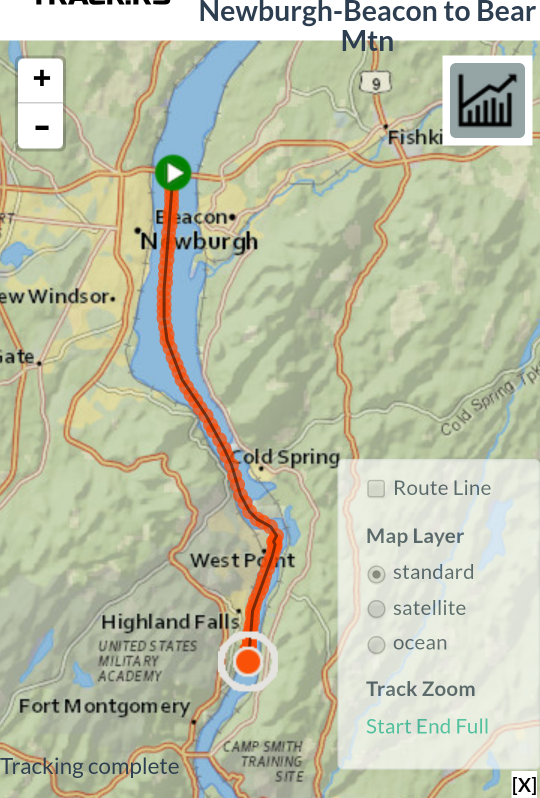
The track Lizzie led me on is a thing of beauty. (Photo credit: track.rs)
A few days later, back at my team’s pool in West Palm Beach, I spoke with my dear coach about what this DNF means. He reminded me that I have lofty goals and with those come harder races, some of which I might fail. Improvement is made by taking on races that seem just beyond my reach, not by taking on the ones where I have a high likelihood to succeed. He reminded me of the words of Michael Jordan, whose work ethic and dedication I hold in high regard: ‘I’ve missed more than 9000 shots in my career. I’ve lost almost 300 games. 26 times, I’ve been trusted to take the game winning shot and missed. I’ve failed over and over and over again in my life. And that is why I succeed.’ My coach asked me if I’d do Stage 4 again. I said I would.
It was a poignant moment seeing Agent Orange, David Barra’s intrepid safety RHIB, tied up at the Washington Irving Boat Club. I was dreamily re-living the week’s swims from the comfort of an Amtrak train back to Albany. It traces the eastern bank of the Hudson, and this journey is the source of my fascination with the Hudson.
Here were the Palisades that we passed just two days ago. And here, in reverse order were all those stunning bridges. The train sped by the large fjord at the Tappan Zee, and on to Bear Mountain, a glorious bridge. I revisited sights along the way which had been made memorable by the commentary provided by Roy, Greg and Rondi on Launch 5.
My own recovery will feature a sad retreat– from writing about this intense experience each day, and from a wide group of people whose company I enjoyed throughout the week. I wondered how the swimmers would manage their physical and mental recovery, though. I knew that full withdrawal may be delayed in some cases, as several swimmers and kayakers were planning to volunteer for the 20 Bridges round Manhattan swim this coming weekend.
Abby Fairman’s recovery was delivered to her right off the boat by an unlikely waiter at La Marina – Ed Riley, his arm draped with a bar towel greeted her with a cold been on a platter.
Harry Finger was staying on for a few days in New York, hoping for a long-delayed massage. Flavio Toi was also looking forward to seeing more of New York and spending time with his son Tiago who swam under the Verrazano Narrows Bridge with him yesterday. His wife Estela would today embrace the prospect of dry land after a nauseous ride across the Battery in the observer boat yesterday. I laughed at the Facebook video of these three friends pretending to swim through Times Square.
During a rather difficult year, I have taken refuge in the prospect of joining the 8 Bridges volunteers, and it has been a huge privilege. I have been encouraged by all the positive comments about the blog from the swimmers, and on Twitter and Facebook. That kept me cranking out the pages each evening. I have shared an extraordinary week and learned not just about marathon swimming, but about determination, perseverance …. and punctuality.
I have appreciated:
The strength and consistency of Stephen Rouch. Focused and dominant, he was never beaten, but he loved a challenge.
The cheerfulness and good humor of Ed Riley, Graco Morlan, Steve Gruenwald and Abby Fairman.
The commitment and disciplined preparation of the Brazilian team. Marta and Flavio just kept getting faster. I will always be grateful for their kindness to me.
The resilience and self-belief of Harry Finger and Jamie Tout.
The persistence of Katrin Walter who struggled with the cold, but kept on turning up and nailed every single other day.
The expertise of the kayakers, and Captain Greg.
I will remember great conversations with Spencer Schneider, Roy Malinak, Devon Clifford, Jackie Boner Luis Lopez, Louise Hyder-Darlington, Pat Kerrigan, Janine Serrell, Greg Porteous and Rondi Davies.
And while I was asking about approaches to recovery after each marathon swim, Ed Riley chipped in, offering his own inimitable remedy. “I have sex”. Of course.