Xon Casino im Fokus: So gelingt dir die sichere Verifizierung und schnelle Auszahlung
Die meisten deutschen Spieler fragen sich, warum sie ihre Ausweisdaten preisgeben müssen, bevor sie Geld abheben können. Die Antwort liegt in der Know‑Your‑Customer‑Regel (KYC). Sie schützt sowohl das Casino als auch dich vor Betrug und Geldwäsche. Ohne KYC‑Verfahren könnten unbefugte Personen dein Konto übernehmen oder illegale Transaktionen durchführen.
Ein weiterer Vorteil ist die schnelle Auszahlung. Sobald deine Identität bestätigt ist, bearbeitet Xon Casino Auszahlungsanträge in der Regel innerhalb von 24 Stunden. Das ist deutlich schneller als bei vielen Mitbewerbern, bei denen die Bearbeitung bis zu fünf Werktage dauern kann.
Was du bei der Verifizierung beachten solltest
Klare Dokumente: Dein Personalausweis oder Reisepass muss gut lesbar sein.
Aktuelle Adresse: Eine aktuelle Rechnung (Strom, Telefon) reicht meist aus.
Keine Manipulation: Fotos dürfen nicht bearbeitet werden, sonst wird die Anfrage abgelehnt.
Statistiken zeigen, dass 85 % der deutschen Online‑Casinos KYC‑Verfahren innerhalb von 48 Stunden abschließen. Xon Casino liegt mit einer durchschnittlichen Bearbeitungszeit von 24 Stunden sogar leicht darüber.
Der Registrierungsprozess bei Xon Casino – Schritt für Schritt
Startseite besuchen – Auf der Hauptseite findest du sofort das Anmelde‑Formular.
Persönliche Daten eingeben – Name, Geburtsdatum und E‑Mail‑Adresse.
Passwort wählen – Achte auf mindestens acht Zeichen, Zahlen und Sonderzeichen.
Bonus ohne Einzahlung aktivieren – Hier kannst du den Xon bonus ohne einzahlung nutzen, um sofort loszuspielen.
E‑Mail bestätigen – Klicke den Link in der Bestätigungsmail.
Nach diesen Schritten bist du bereit, dein erstes Spiel zu starten. Die Plattform ist komplett auf Deutsch verfügbar und bietet eine intuitive Benutzeroberfläche, die sowohl Anfängern als auch erfahrenen Spielern gerecht wird.
Spielauswahl und Jackpots – Was Xon Casino besonders macht
Xon Casino arbeitet mit führenden Software‑Providern wie NetEnt, Microgaming und Play’n GO zusammen. Das Ergebnis ist ein breites Portfolio von über 2 000 Spielen, darunter:
Progressive Jackpot‑Slots wie Mega Moolah und Hall of Gods
Progressive Jackpots können bis zu 10 Millionen Euro erreichen. Die Gewinnwahrscheinlichkeit liegt bei etwa 1 zu 10 Millionen, aber die Chance auf kleinere Auszahlungen ist deutlich höher. Xon Casino informiert transparent über die Jackpot‑Statistiken jedes Spiels, sodass du immer weißt, woran du bist.
Schnelle Auszahlungen und sichere Zahlungsmethoden
Ein häufiges Ärgernis bei Online‑Casinos ist die lange Wartezeit bei Auszahlungen. Xon Casino löst dieses Problem mit mehreren schnellen Zahlungsmöglichkeiten:
Sofortüberweisung – Auszahlung in 15 Minuten
Trustly – Direkt vom Bankkonto, bis zu 30 Minuten
Kreditkarte – Bearbeitung innerhalb von 24 Stunden
Laut einer Branchenstudie erhalten 72 % der Spieler bei Xon Casino ihre Gewinne innerhalb eines Tages. Das liegt deutlich über dem Durchschnitt von 48 Stunden in der deutschen Marktlandschaft.
Kundenservice und verantwortungsvolles Spielen
Ein guter Kundenservice ist ein Zeichen für ein vertrauenswürdiges Casino. Xon Casino bietet Live‑Chat rund um die Uhr und eine telefonische Hotline, die innerhalb von 5 Minuten reagiert. Das Support‑Team ist mehrsprachig und kann bei Fragen zur Verifizierung, Bonusbedingungen oder technischen Problemen helfen.
Verantwortungsvolles Spielen wird großgeschrieben. Du kannst Limits für Einzahlungen, Verluste und Sitzungsdauer festlegen. Außerdem gibt es Selbstsperr‑Optionen und Links zu Beratungsstellen wie Spielberatungs‑Hotline.
Praktische Tipps für eine reibungslose KYC‑Abwicklung
Scanne Dokumente in hoher Auflösung – Mindestens 300 dpi.
Verwende dieselbe Adresse wie auf deinem Ausweis.
Lade alle geforderten Unterlagen gleichzeitig hoch, um Nachfragen zu vermeiden.
Prüfe deine E‑Mail‑Postfach regelmäßig, falls das Casino weitere Informationen benötigt.
Durch diese einfachen Schritte reduzierst du die Verifizierungszeit auf ein Minimum und kannst deine Gewinne schneller genießen.
Fazit: Warum Xon Casino die clevere Wahl ist
Nach gründlicher Analyse aller Aspekte – von der schnellen KYC‑Prüfung über die riesige Spielauswahl bis hin zu raschen Auszahlungen – lässt sich klar sagen, dass Xon Casino ein besonders benutzerfreundliches und sicheres Angebot für deutsche Spieler darstellt. Die Plattform kombiniert verlässliche Lizenzierung, hochwertige Software und exzellenten Kundenservice.
Für alle, die jetzt sofort loslegen wollen, bietet das Casino den Xon bonus ohne einzahlung an. Dieser Bonus ermöglicht dir, ohne eigene Einzahlung erste Einsätze zu tätigen und die Qualität der Spiele zu testen. So kannst du dich von den schnellen Auszahlungen und der unkomplizierten Verifizierung selbst überzeugen.
Setze dir klare Limits, genieße die Vielfalt der Slots und Jackpots und profitiere von einer der schnellsten Auszahlungsprozesse im deutschen Markt. Xon Casino ist damit nicht nur ein weiteres Online‑Casino, sondern ein Partner, der dir ein sicheres und unterhaltsames Spielerlebnis bietet.
Lemon Casino: Wie transparente Blockchain‑Technologie das Online‑Glücksspiel verändert
Viele Einsteiger konzentrieren sich nur auf den ersten Bonus. Sie übersehen dabei die langfristige Spielqualität und die Sicherheit der Plattform. Ein häufiger Fehler ist, sich von hohen Willkommensboni blenden zu lassen, ohne die Auszahlungs‑ und Lizenzbedingungen zu prüfen.
Lemon Casino bricht mit diesem Trend, indem es Blockchain‑Technologie nutzt, um jede Transaktion nachvollziehbar zu machen. Das Ergebnis: Spieler sehen sofort, wo ihr Geld hinfließt und können die Fairness der Spiele prüfen.
Die Evolution der Transparenz im Online‑Casino
Früher basierten Online‑Casinos auf proprietären Zufallszahlengeneratoren (RNG), deren Funktionsweise selten offengelegt wurde. Heute ermöglichen dezentrale Ledger, dass jede Spielrunde kryptografisch gesichert und öffentlich einsehbar ist.
Vertrauenswürdigkeit: Durch die unveränderliche Aufzeichnung wird Manipulation praktisch unmöglich.
Schnelle Auszahlungen: Kryptowährungen können in wenigen Minuten auf das Wallet des Spielers überwiesen werden.
Einfache Nachverfolgung: Spieler können jede Runde mit einer Transaktions‑ID prüfen.
Lemon Casino hat diese Vorteile in seine Plattform integriert und bietet sowohl klassische Zahlungsmethoden als auch Krypto‑Ein‑ und Auszahlungen an.
Praktische Tipps, um das meiste aus dem Lemon Casino‑Bonus herauszuholen
Registriere dich und nutze den Bonus ohne Einzahlung – Du kannst sofort mit echtem Geld spielen, ohne zuerst zu zahlen.
Aktiviere den Willkommensbonus – Er verdoppelt deine erste Einzahlung bis zu 500 €.
Lies die Wettanforderungen – Beim Lemon Casino betragen sie 30‑fach, was im Branchenvergleich moderat ist.
Ein Beispiel: Du setzt 20 € ein, erhältst 20 € Bonus ohne Einzahlung und spielst einen Slot mit 96,5 % RTP. Nach 100 € Einsatz (inkl. Bonus) kannst du theoretisch 96,5 € zurückerhalten, bevor die 30‑fach‑Wette erfüllt ist.
Vergleich: Lemon Casino vs. klassische Online‑Casinos
Merkmal
Lemon Casino (Blockchain)
Klassisches Online‑Casino
Auszahlungszeit
Minuten bis Stunden (Krypto)
24‑48 Stunden (Bank)
Transparenz
Vollständig einsehbar
Eingeschränkt
Bonusangebot
Willkommens‑ + No‑Deposit
Oft nur Willkommens‑Bonus
Spielauswahl
1500+ Slots, Live‑Dealer
1200+ Slots, Live‑Dealer
Lizenz
Malta Gaming Authority
Diverse EU‑Lizenzen
Die Tabelle zeigt, dass Lemon Casino in puncto Geschwindigkeit und Nachvollziehbarkeit klar vorne liegt.
Live‑Dealer‑Erlebnis: Der neue Standard
Live‑Dealer‑Spiele verbinden das Flair eines echten Casinos mit der Bequemlichkeit des Home‑Gaming. Beim Lemon Casino werden die Tische von professionellen Croupiers geleitet, die über HD‑Streams in Echtzeit übertragen werden.
Interaktive Chat‑Funktion ermöglicht Fragen an den Dealer.
Mehrsprachiger Support – Deutsch, Englisch, Spanisch.
Schnelle Ein‑ und Auszahlungen direkt nach dem Spielabschluss.
Ein Spieler berichtete, dass er nach einem 30‑Minuten‑Live‑Blackjack‑Spiel sofort 150 € per Bitcoin erhalten habe – ein Vorgang, der in traditionellen Casinos Tage dauern kann.
Verantwortungsvolles Spielen und Sicherheit
Lemon Casino legt großen Wert auf Spielerschutz. Das System bietet:
Selbstlimits für Einzahlungen, Verluste und Sitzungsdauer.
Selbstausschluss‑Option für 24 Stunden bis 6 Monate.
Zwei‑Faktor‑Authentifizierung zum Schutz des Kontos.
Denke immer daran: Setze nur Geld ein, das du dir leisten kannst zu verlieren.
FAQ
Q: Wie lange dauert eine Auszahlung bei Lemon Casino?
A: Kryptowährungs‑Auszahlungen werden meist innerhalb von 15 Minuten bis zu einer Stunde bearbeitet. Banküberweisungen benötigen 24‑48 Stunden.
Q: Ist der Bonus ohne Einzahlung wirklich kostenlos?
A: Ja, du erhältst das Geld ohne eigene Einzahlung, musst jedoch die Wettanforderungen von 30‑fach erfüllen, bevor du Gewinne abheben kannst.
Q: Welche Spiele bieten die höchste Gewinnchance?
A: Slots mit einem RTP von 96 % oder höher, wie „Starburst“ oder „Book of Dead“, gelten als besonders günstig.
Q: Kann ich meine Gewinne sofort wieder einsetzen?
A: Nach erfolgreicher Verifizierung kannst du Gewinne sofort für neue Einsätze nutzen oder auszahlen lassen.
Fazit: Der nächste Schritt für clevere Spieler
Transparenz, Geschwindigkeit und ein großzügiges Bonuspaket machen Lemon Casino zu einer der attraktivsten Optionen auf dem deutschen Markt. Die Kombination aus Blockchain‑Sicherheit und einem breiten Angebot – von klassischen Slots bis zu Live‑Dealer‑Tischen – spricht sowohl Anfänger als auch erfahrene Spieler an.
Wenn du bereit bist, ein Casino zu erleben, das deine Einlagen schützt und dir schnelle Auszahlungen garantiert, dann mehr erfahren und teste die Plattform selbst.
Hinweis: Dieser Artikel dient nur zu Informationszwecken. Glücksspiel kann süchtig machen. Bitte spiele verantwortungsbewusst.
Erfolgreich durch die Playoffs: Wie du mit Ice Fishing Casino deine NBA‑Wetten optimierst
Die NBA‑Playoffs sind jedes Jahr ein Magnet für Sportwetten‑Fans. Während die Spannung auf dem Platz steigt, suchen clevere Spieler nach Wegen, ihre Gewinne zu maximieren. In diesem Beitrag zeigen wir dir, wie du mit fundierten Analysen, cleveren Bonus‑Strategien und dem Ice Fishing Casino das Beste aus den Playoffs herausholst.
Daten zeigen, dass Spieler, die systematisch vorgehen, ihre Gewinnrate um bis zu 27 % steigern. Eine aktuelle Studie belegte, dass Ice Fishing Casino Deutschland offiziell mit einem durchschnittlichen Auszahlungszeitraum von nur 18 Stunden zu den schnellsten Anbietern im deutschen Markt zählt. Diese Geschwindigkeit ist besonders wichtig, wenn du schnelle Gewinne aus deinen Playoff‑Wetten reinvestieren möchtest.
Warum die Playoffs ein besonderes Wettfeld sind
Die Playoffs unterscheiden sich stark von der regulären Saison. Jeder Spielzug hat höhere Konsequenzen, und die Teams passen ihre Taktiken oft an. Das bedeutet, dass traditionelle Vorhersagemodelle nicht mehr ausreichen.
Intensivere Defensive: Teams setzen häufiger auf Doppelverteidigungen, was die Punktzahlen senken kann.
Star‑Leistung: Einzelne Superstars tragen oft den größten Teil der Punkte.
Coach‑Entscheidungen: Rotationsänderungen und Timeout‑Management werden kritischer.
Pro Tip: Verfolge die letzten drei Spiele jedes Teams vor den Playoffs. Sie geben Aufschluss über Form und mögliche Taktik‑Wechsel.
Der Ice Fishing Casino Bonus ohne Einzahlung – dein Startkapital
Ein häufiges Problem für neue Wettende ist das fehlende Startkapital. Hier kommt der Ice Bonus ohne Einzahlung ins Spiel. Nach der Registrierung erhältst du ein kleines Guthaben, das du sofort für NBA‑Wetten einsetzen kannst – ohne eigenes Geld zu riskieren.
Beispiel: Anna meldet sich bei Ice Fishing Casino an, nutzt den Bonus ohne Einzahlung von 10 €, und legt 5 € auf das Spiel „Lakers vs. Celtics“. Ihr Gewinn von 15 € kann sofort wieder in weitere Wetten investiert werden.
Spielauswahl: Online‑Slots vs. Live‑Dealer‑Wetten
Im Ice Fishing Casino hast du nicht nur klassische Sportwetten, sondern auch Online Spielautomaten und Live‑Dealer‑Spiele. Für Playoff‑Fans bieten Live‑Dealer‑Tische mit Basketball‑Themen ein immersives Erlebnis.
Live‑Dealer‑Wetten: Setze direkt während eines Spiels auf Echtzeit‑Ereignisse wie „Nächster Korb von LeBron James“.
Online‑Slots: Spiele Slots wie „Court Kings“, die NBA‑Symbole und Freispiele enthalten.
Industry Secret: Slots mit hoher Volatilität zahlen seltener, aber dafür größere Beträge – ideal für Spieler, die bereit sind, ein höheres Risiko einzugehen.
Schnell registrieren und loslegen – so funktioniert es
Registriere dich bei Ice über die Startseite.
Verifiziere deine E‑Mail und wähle ein sicheres Passwort.
Aktiviere den Willkommensbonus – bis zu 200 % Bonus auf die erste Einzahlung.
Nach diesen Schritten stehen dir über 2000 Online Spielautomaten und das komplette Sportwetten‑Portfolio zur Verfügung.
Did You Know? Die Registrierung bei Ice Fishing Casino dauert durchschnittlich nur 2 Minuten, was deutlich schneller ist als bei vielen Konkurrenzseiten.
Auszahlungsgeschwindigkeit – warum sie zählt
Bei Playoff‑Wetten kann es entscheidend sein, Gewinne schnell zu erhalten, um weitere Chancen zu nutzen. Ice Fishing Casino bietet Blitz‑Auszahlungen über gängige E‑Wallets (Skrill, Neteller) innerhalb von 30 Minuten. Banküberweisungen werden in der Regel innerhalb von 24 Stunden bearbeitet.
Pro Tip: Nutze E‑Wallets für sofortige Auszahlungen und vermeide lange Banklaufzeiten.
Verantwortungsvoll spielen – deine Sicherheit steht an erster Stelle
Egal wie verlockend die Playoffs sind, immer verantwortungsbewusst wetten. Setze dir klare Limits, halte Pausen ein und nutze die Selbstsperr‑Funktion von Ice Fishing Casino. Das Casino ist lizenziert durch die Malta Gaming Authority und nutzt modernste Verschlüsselung, um deine Daten zu schützen.
FAQ zum Wetten bei den NBA‑Playoffs
Q: Wie kann ich den Ice Bonus ohne Einzahlung aktivieren?
A: Nach der Registrierung loggst du dich ein, gehst zum Bonus‑Bereich und klickst auf „Aktiviere Bonus ohne Einzahlung“. Der Betrag wird sofort deinem Konto gutgeschrieben.
Q: Welche Zahlungsmethoden sind am schnellsten?
A: E‑Wallets wie Skrill und Neteller ermöglichen Auszahlungen innerhalb von 30 Minuten. Kreditkarten brauchen meist 1‑2 Tage.
Q: Gibt es spezielle Playoff‑Wettmärkte?
A: Ja, Ice Fishing Casino bietet Live‑Wetten auf Punkte, Rebounds, Assists und sogar auf den ersten Korb des Spiels.
Q: Wie sicher ist mein Geld bei Ice Fishing Casino?
A: Das Casino ist durch die Malta Gaming Authority reguliert, verwendet SSL‑Verschlüsselung und hält strenge KYC‑Richtlinien ein.
Fazit: Mit Ice Fishing Casino zum Playoff‑Erfolg
Die NBA‑Playoffs bieten eine einzigartige Gelegenheit, deine Wettfähigkeiten zu testen. Durch die Kombination aus datenbasierten Analysen, dem Ice Bonus ohne Einzahlung, schnellen Auszahlungen und einer breiten Spielauswahl hast du alle Werkzeuge, um deine Gewinnchancen zu maximieren.
Registriere dich noch heute, nutze den Willkommensbonus und starte deine Playoff‑Strategie bei Ice Fishing Casino – dem zuverlässigen Partner für deutsche Spieler. Viel Erfolg und spiel verantwortungsbewusst!
One of the greatest joys in my life is learning something new. From an early age I was fascinated by knowledge, especially the knowledge that came from books. My grandparents had a set of encyclopedias in their house and I would spend hours turning the pages and looking at the photographs even when I didn’t know what the words meant. As a young girl, the library was a favorite place and I would cloister myself in my room reading about the adventures of Alec and his black stallion. As long as it could capture my imagination, I would read it. That love of learning new things continues to this day. It might be a fact about an important historical figure or how to prune an overgrown tomato garden. The subject doesn’t matter as long as I find the topic interesting. In the last few months I’ve read books about John Kennedy, about what it’s like to be a bird (which is pretty freaking amazing) and about Native American history. I’ve read about training a dog and about the civil war in El Salvador. Reading in itself is a great gift and easily my favorite way to spend a day, but it also gifted me with the knowledge that reading is only the beginning of learning. True learning comes from reflecting on what you’ve read and eventually it taught me how to reflect on my experiences as well.
The thing that I love most about marathon swimming is its ability to teach you something every time you jump in the water. And whether you want it or not, it is usually a lesson hard learned. Among other things, it can teach us about perseverance and resilience, about success and failure and about friendship and community. Through swimming, I’ve learned a great deal about body awareness and how the relationship between the physical and mental aspects of sport is complex and variable. I’ve learned how my body reacts when I’m swimming on less than ideal sleep or didn’t eat enough the previous days. Through trial and painstaking error I’ve mostly solved how to dig myself out of a mental black hole. I try to view each swim as a learning opportunity especially when things don’t go as planned. Being in the water for hours on end has given me the chance to explore my own character strengths and weaknesses and I’ve come to enjoy reflecting on how a swim shapes me outside of the water as well.
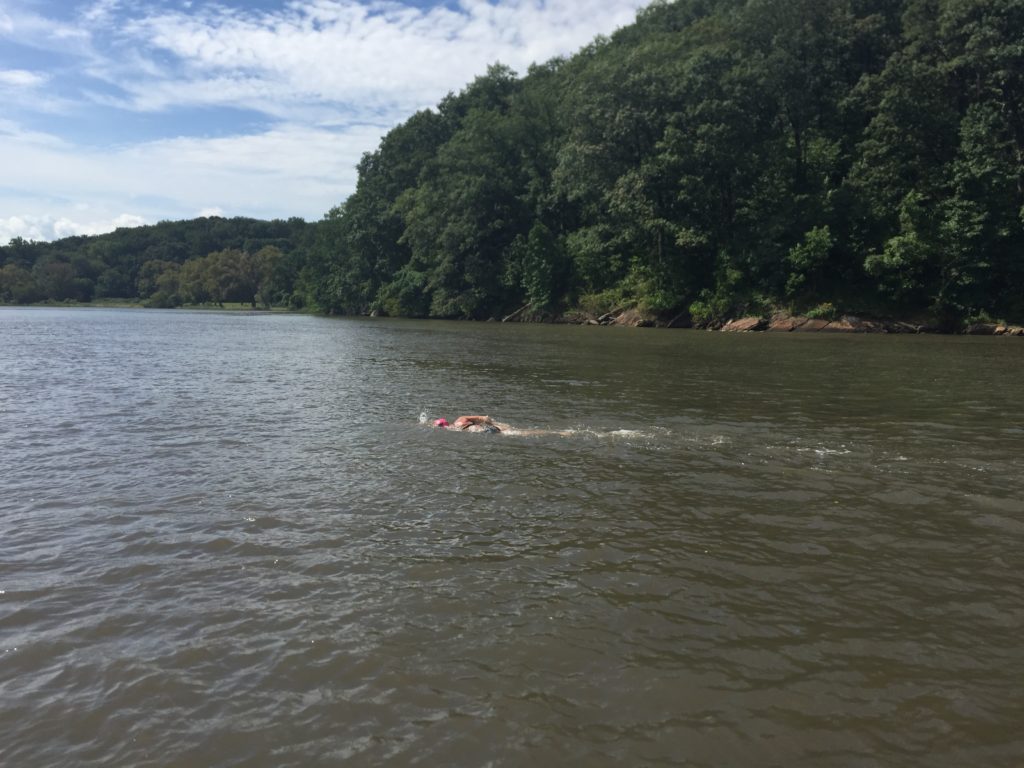
Most swimmers have a favorite body of water or place to swim. These places usually evoke something in me akin to the feeling of being in love. It is intangible and ethereal, defying description in mere words. And much like being in love, it can be complicated and daunting but also provide a tremendous amount of joy and delight. My gateway to marathon swimming took place 10 years ago in the Hudson River. It was a current assisted 10k from the Upper West Side to Inwood Canoe Club. The swim was dubbed the Little Red Lighthouse swim because it passes by a small lighthouse on the New York side of the George Washington Bridge. I knew nothing about the the history of the landmark at that time but later discovered the lighthouse was originally called the North Hook Beacon at Sandy Hook where it was originally built and existed until 1917. Four years later it was reconstructed at its current site and remains there to this day. My memories from that day are remarkably clear. I vividly recall that I was petrified to jump into the Hudson River. At the same time I knew it would be a super cool experience and a great adventure. So, on that late September day, I jumped off a dock into the Hudson River and a great love was born.
I remember feeling like I was flying up that waterway on the incoming tide, exhilarated by the experience, but also completely awed by the immensity of its expanse. I easily recollect how insignificant I felt in the grips of the current and also how elated I felt finishing. The Hudson and I were off to a smashing start. Little did I know that a few years later I would have a wildly different encounter further north in those waters. I experienced my first Did Not Finish (DNF) at the hands of that mighty current. The swim took place near Poughkeepsie between two bridges, hence its name, and although it is shorter in length it remains one of the more challenging courses I’ve done. On that day I was pulled from the water so close to the Mid-Hudson Bridge because I missed the cutoff for finishing. I swam in place for almost an hour and could have spent the better part of the day fighting that current to no avail. As I flipped on my back and drifted down to the dock, I knew that I had given it my best shot and would come back next year a little wiser about swimming against a current. So, I kept showing up at these swims and my love for this mercurial river continued to grow.
Over the next few years I had several successful swims in her waters, including an electric swim down the Hudson during a Manhattan circumnavigation that I will remember to my dying day. In retrospect, I probably grew a little complacent with my love. And then a few years later, it was time for another lesson. Another DNF. It was a picture perfect day but I had struggled with feeling cold during the previous day’s swim and simply gave up. I regretted that decision immediately and promised myself that I would never quit simply because I felt uncomfortable. A few days later I swam a much more difficult part of the Hudson on a less than perfect day and battled through the discomfort to finish. During that swim I talked a lot to the river. I begged her to let me finish. I swore that I wouldn’t take her for granted. And she acquiesced to my pleas. Since then I’ve done several longer and more difficult swims. I thought my days of not finishing a swim were behind me. Haha!
In June I had planned to spend a week swimming down the Hudson River. It was cancelled like virtually everything else. I was disappointed that I wouldn’t get a chance to spend at least one day this summer enveloped in her majestic waters. I had done two significant swims in July that included the Verrazano Narrows Bridge and I thought it would be well chosen that my final swim of the season included both the Hudson River and this bridge. I made mistakes from the beginning. I didn’t realize how difficult or long this swim would be until I started chatting with Alex about strategy. I was shocked to learn that I would be swimming against the current for several hours. I didn’t relish the thought of knuckle dragging against the rocks for hours but I figured I could do it again. I didn’t bring enough warm feeds and tried something new. I changed the interval of my feeds hoping that would keep me warmer. Again, my complacency with this river got the better of me.
I have to go back several months in order to answer the question of what REALLY went wrong with this swim. I’ll spare you the gory details but sometime around May I started experiencing panic attacks. If you never had one they are scary and disorienting. I’d feel like my sense of spacial organization was completely warped and that I was going to pass out. Not fun at all. But in this age of modern pharmaceuticals there is a pill or pills for everything. I’ve never taken a medication continuously at any point in my life. I preferred to use things like diet and exercise to manage stress and anxiety. But my usual fallbacks weren’t working so I said yes to the medications. No one tells you that these pills come with a laundry list of side effects. Apart from the ones too embarrassing to share, my main complaints were that they made me nauseous and dizzy. My anxiety improved so I thought the trade off was worth it. Until I had another panic attack. By this point I knew the precursors and what was happening but this one hit me like a freight train. Afterwards my body shook for a long time. I was angry at what I perceived as a betrayal by my mind and afraid that these attacks would never go away no matter how many pills I consumed.
I have to say I didn’t go into Stage 7 in the best mental or physical shape. It’s taken me a few days to admit that myself. I had been struggling at work and took a leave of absence. Stress was making me physically ill in addition to the side effects of the medications I was taking. I had been slowly improving though and thought I could deal with doing a long, physically demanding swim. I was wrong. Almost four hours into the swim my body made the decision that this was over for me. I had been battling nausea for most of the morning but there was no way I was going to quit because I felt a little sick. I knew I could work through it. I had been doing it for weeks. I asked the river to help me and I talked to her for a long time. I felt her hesitation as the wind started to pick up. And then I felt the beginnings of a panic attack. I swam over to the kayak and wrapped my hand around a rope, petrified I was going to black out and drown. Sitting on the boat afterwards I knew I had made the right decision to get out. I had put a lot of pressure on myself to have a successful swim and it blew up in face. My body and my mind decided that I had done enough. Surprisingly, I’m okay with that. I spent four hours swimming in my favorite place. I learned to never underestimate the challenge of doing a long swim. Most importantly though, I realized that my expectations were overshadowing the simple pleasure of swimming.
I took a day to wallow in self-pity and the next day, with the help of my loving pod of swim friends, I got back in the water. I thought about that day 10 years ago on the dock in the Hudson River and how glad I was to overcome my fear. I tried to channel that courage as I stepped into the water unsure of what to expect. For some irrational reason, part of me wasn’t sure I’d ever be able to swim again. I told myself I was in a body of water that I knew and I tried to embrace the experience. And the next day I did the same thing. And the next the same. My confidence came back. I forgave myself being such perfectionist and for taking myself a little too seriously, both things I struggle with on a daily basis. Next week I’ll jump into the Hudson again with another loving friend by my side for a fast 10k. I’ll thank the river for giving me the chance to have fun in her world and for teaching me that I need to be a little more gentle and forgiving of myself. It’s great to have goals and want to achieve big things. I know now there is a time and place for that and I look forward to completing that swim sometime in the future. But right now, it feels really good to simply be able to swim.
When I do a long swim there are lots of ways that I keep my mind occupied. Most of the time, I’m just concentrating on my stroke, focusing on rotation, the catch and the feel of my hand as it pulls the water. Maybe I’ll count strokes or see how far I can lengthen out my body as I become more tired. Sometimes I think about the people that inspire me or those in my life that I love and give me support. Like the family and friends from every corner who watch the progress of a swim and cheer me on from home. I think about my Mom who died a long time ago and how much I wish she could be here to see me swim. I wonder about the history of the water that I’m moving through and the women and men that navigated this fluid space lifetimes ago. And, like many other swimmers, I sing songs to myself to pass the time. The other day while swimming a verse from the Simon & Garfunkel song, “The Only Living Boy in New York”, kept popping into my head. Strangely fitting that as I was stroking my way to Manhattan this song should be the one the DJ in my brain decided to keep repeating.
“I get the news I need on the weather report I can gather all the news I need on the weather report Hey, I’ve got nothing to do today but smile Do-n-doh-d-doh-n-doh and here I am The only living boy in New York
Half of the time we’re gone But we don’t know where, And we don’t know where…”
I felt like there were so many months recently when smiling felt like a herculean effort. My prevailing state of mind was dominated by anxiety and a lot of anger. I was devastated when the pools closed in March and all my planned swims for the spring and summer were cancelled. As the days without water continued, I mourned the loss of my swim fitness that I worked so hard to build over the winter months. It physically hurt to not have anything to look forward to on the calendar. For over a decade, I’ve had a big goal each year. At one time it was my first 5k run. Last summer I swam the 25 mile length of Lake Memphremagog. This year I planned on doing two big multi-day swims, SCAR and all of 8 Bridges. But most crushingly of all, I lost my outlet and escape just when I needed it most. When I’m swimming I can find some head space in the rhythm of the strokes. It is my ritual and routine and losing it felt like I had lost a part of myself. Simply put, I was an emotional mess.
Those early months during the pandemic seem surreal to me even now. I would turn on the news and hear our leaders urging us to stay home. People were being asked not to go out except for emergencies and essential supplies. The images of deserted city streets was haunting. New York and New Jersey were seeing their curves rise at an alarming rate. Schools closed and businesses shut their doors. I watched as the normally busting hospital where I worked was transformed into an eerily quiet and empty space in order to care for those patients that were beginning to trickle through the door. Screening tents were erected in parking lots, entire inpatient units were being closed and reconfigured and normal services were shutting down. New recommendations were being made every day. Guidelines for patient care would change multiple times, sometimes in the same day. It was confusing and scary and I cried on the way home from work for almost a month.
I knew that I had to do something to put an end to this cycle of anxiety and fear. So, I stopped watching the news so much. None of it was good anyway and it was making me crazy. I would read a story about an overwhelmed hospital in New York and my heart would break for the patients and the people who were trying their best to care for them. My being ached for the families that couldn’t say good-bye to their loved ones in person. I was disappointed in the lack of leadership in this country and angry that we didn’t have the necessary equipment to adequately protect ourselves at work.
When it all got to be too much, I’d turn the channel to the weather report. If I woke up and it was sunny, I knew I’d have an okay day because I could get outside to move around. I started running again after many years off. I went for long walks in the park with my dog. When even that shut down, we moved to the beach. I found ways to keep myself occupied inside when it was dreary and raining. I’d do yoga classes online. I read good books and cooked. I picked up a guitar and started teaching myself to play. And gradually, I started to feel less panicked when I had to go to work. It wasn’t easy. I was scared to walk through the door. I would lay in bed at night thinking that I would get sick from a workplace exposure. We were all fearful for ourselves, for our families and friends and for each other. No one really knew what was going on and the environment was filled with uncertainty and tension.
It was many, many weeks before I started swimming again. The water was cold and I wore a wetsuit but I was out there in the open water and I smiled. A little at first and then a lot more. I met a group of intrepid athletes and we explored all the waters surrounding our peninsula. We swam in rivers and bays and creeks and eventually the ocean again. I took off the wetsuit (hallelujah!). I got back my feel for the water and my mind turned to figuring out a way to do a meaningful swim during this strange and eventful summer. As our national tragedy continued to unfold, I wasn’t sure it would be possible or frankly, appropriate, to do a long swim. Yet, I couldn’t help but dream about doing something to make this dark year a little brighter. The obvious choice was the Ederle swim. In 1925, Ederle broke the men’s record for the swim from the Battery to Sandy Hook in New York Bay. According to the New York Times article on the swim, she was also the first “swimmer of her sex” to complete this course. Ederle was a pioneer for women in swimming and I admired her deeply for her guts and perseverance.
When Rondi at NYOW gave me the option to swim the reverse route, I jumped at the chance. Because I knew it would be harder. Because I wanted to swim from my home state across those waters to where I went to school and learned how to be a nurse. Because I wanted to say “fuck it” to all the fear I had felt since March. And because I knew it would be a heck of a swim if I made it. Stepping off that beach in Sandy Hook was cathartic. I thought about Ederle, who swam in these waters since she was a child and eventually became the first woman across the English Channel. Her love for the water and her spirit for life were with me as I took my first few strokes. The day was sunny and forecasted to be very hot. There was a stiff wind blowing out of the west. The water was sublime and, even though I was undertrained, I had confidence that we would achieve our goal.
The crossing to the Verrazzano Bridge was a crawl against strong cross winds and a nearly non-existent current assist. I stopped a lot. I lost my rhythm. I did a lot of cursing. It occurred to me that we wouldn’t make it to the Battery before the tide turned. Based on Rondi’s timeline, I knew we were behind schedule. As usual, Alex kept me moving forward. He told me to quit stopping and start swimming. I could hear Sharon cheering from the boat. I was so happy she was able to be our official observer and her energy and positivity boosted my spirits. Sean and Tom guided us across shipping lanes and kept a watchful eye between us and the giant container ships that seemed to pass a little too closely for my comfort. Andy was somewhere on the other side of the kayak swimming with me stroke for stroke. I was right where I needed to be. I thought about Ederle making her way against the current and decided I wasn’t going to give up. I put my head down and really started to swim. My rhythm came back as I relaxed my body and settled my mind. I started to smile. A little at first and then a lot more.
As we passed under the bridge and made our way into New York Harbor, I mostly focused on swimming. But I also thought about how these times have changed us all in so many ways. These past months have shown me the very worst but also the very best in people. I’ve seen ordinary people turn into heroes and have witnessed first hand the generosity and love of my community. I rediscovered activities that make me happy. My life became more balanced and less one dimensional. I’ve learned that much like a swim, there is only so much of life that we can control. Maybe the conditions are less than ideal or we weren’t able to train as much as we wanted. Sometimes you just have to let it go and move forward anyway. I realized that it’s okay to put aside the burdens of the world for a day and do a thing that makes your soul catch fire while you have the chance. I felt more free than I had in a long time. As we approached Governors Island I let out a little yelp and saw Alex grin. And I sang to myself, “I’ve got nothing to do today but smile…”
By Rondi Davies. Photo credits: Janet Harris, Sharon Gunderson, Courtney Moates Paulk.
Reverse Manhattan Swim History
Kris Rutford was the first to swim a Reverse Manhattan in August, 1995 in a time of 17:48:30. Liz Fry completed the swim on September 18, 2009 in a time of 11:44:05 with a start and finish at the Willis Avenue Bridge in the Harlem River.
Planning
I’ve been fascinated by the
Reverse Manhattan swim since I followed Liz Fry’s swim, and it’s been a goal to
attempt it for a few years. However, since becoming a parent it hasn’t been
possible for me to train enough to realistically attempt any marathon swim.
Courtney Moates Paulk has been eager to try the Reverse swim with NYOW; her persistence was the push I needed to find a date, commit, and get somewhat prepared (I wasn’t going to organize this swim and not try it myself). After hiring coach Abby Fairmain last December, I had put in a minimal amount of pool training and a good number of marathon swims during the summer (8 Bridges Stages 0, 2, 5, 6 and Kingdom Week days 1,2,3 including an 18 mile double crossing of Lake Massawippi in Quebec).
I chose Sunday, September 1 for the fast tidal currents (which are needed to get up the Hudson) and warm water. September 28 offered a faster tide, but cooler water. Plus New York City closes its pools for maintenance after Labor Day, so I would miss valuable pool time in the lead up. In addition, September 1 worked best as I just started a new job, the kids are headed back to school, and lawyer Courtney had a big court case coming up.
Model
Andrew Malinak and I independently prepared models for the swim. Considering my open water pace (of 3.45 km/hr with feeds and waves) determined from my recent Vermont swims, we both predicted a time of 8 hours 44 minutes. Our models matched almost exactly for the different locations on the course, which usually doesn’t happen when we model the counterclockwise 20 Bridges swims. I was excited the swim could be so fast and was mentally preparing for a nine-hour, record shattering swim.
The swim would start with the Hudson flood, so the current is building and peaking as we reach the George Washington Bridge, about 12 miles upriver. After four hours in the Hudson, swimmers enter the Harlem in the dying flood and are confronted by the ebb current several miles later. I calculated this to be around the Madison Avenue Bridge, five miles into the Harlem. Then swimmers must fight the ebb current until Mill Rock, spending a total of 3.5 hours in the Harlem River.
At Mill Rock swimmers join the fast (up to 5 knots) outgoing ebb of the East River. The goal would be to work hard for the first seven to eight hours to be sure to make the most of the Hudson and Harlem flood currents. In the Harlem, we were to hide from the ebb on the sea wall to make progress. Once in the of the East River the water would be with us and we could relax and almost float to the finish.
My head space
Life is busy so there wasn’t a lot of time to mentally prepare. NYOW hosted a 16-swimmer 20 Bridges swim the day before (8/31), so I was caught up in that, but at least not on the water. I told NYOW co-founder David Barra the swim was almost an academic exercise in mastering the currents in the reverse format, and trying for a record swim time as a bonus. The stakes were low, since the swim was almost an experiment, and so my anxiety levels were reasonably low. Andy bought my feeds while I worked the swim on Saturday. I threw everything in a bag the night before, but in my scattered state forgot to give Andy my teams contact info.
The Team
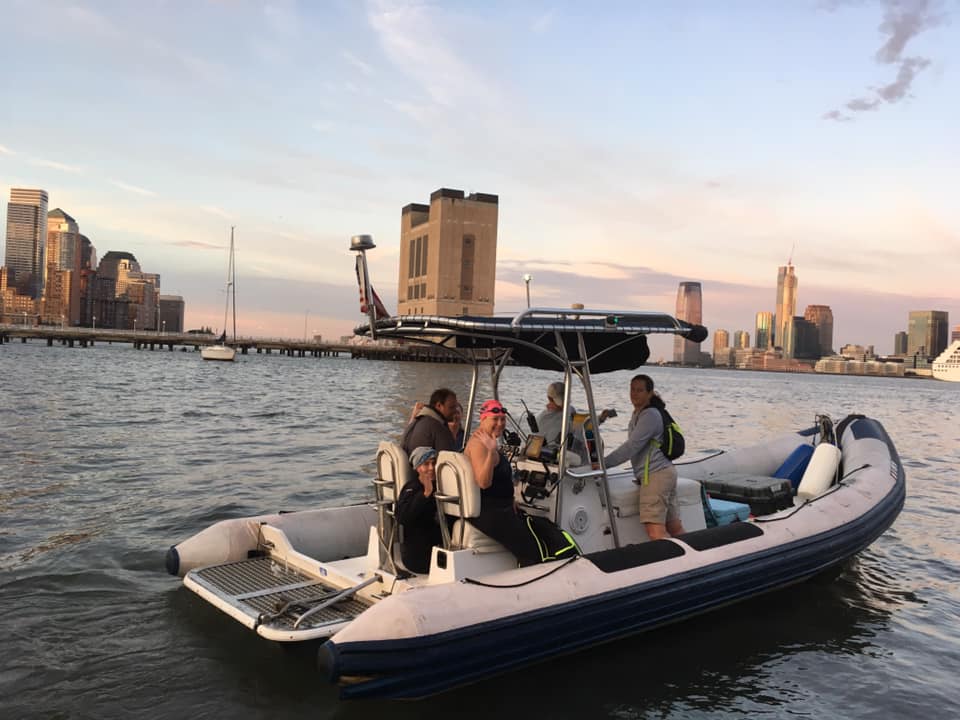
We met at Pier 40 just before the 6 AM sunrise. My team consisted of crew person Janet Harris, observer Dana Page, and kayakers, Luis Lopez and Alex Arévalo. Janet is a good friend and accomplished and experienced marathon swimmer. Dana is marathon swimmer and exceptional volunteer for NYOW (also a paramedic and public defender). She delayed her trip back to DC after 20 Bridges the previous day to observe my swim. Alex and Luis have done 12 swim support circumnavigations of Manhattan this season alone and were excited to see the swim in reverse. Having two kayakers felt decadent, but it was an immeasurable help once we were fighting the current in the Harlem.
We chatted with Courtney and her crew Liz Fry, the Reverse record holder, and busily prepared before loading the RHIBs. Pat Kerrigan and Terry Lopatosky as kayaker and observer rounded out Courtney’s team. Janine Serell was at the dock to wish us well and helped set the tone for a relaxed and fun day. “Remember that these are your home waters” were her words of wisdom before we parted. Sean Makofsky, Thomas Crystall and Rick piloting RHIBs arrived and we motored to the Staten Island Ferry Terminal at the southern tip of Manhattan.
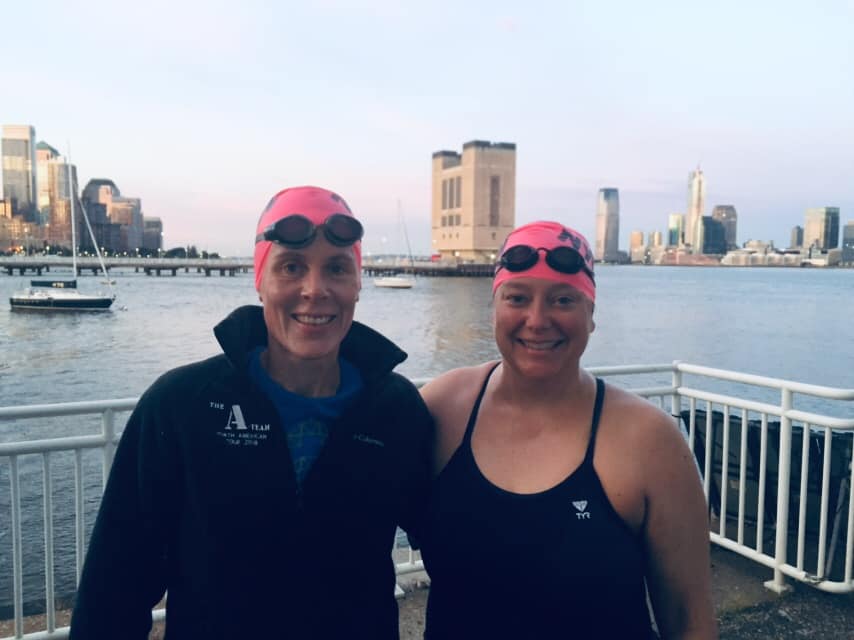
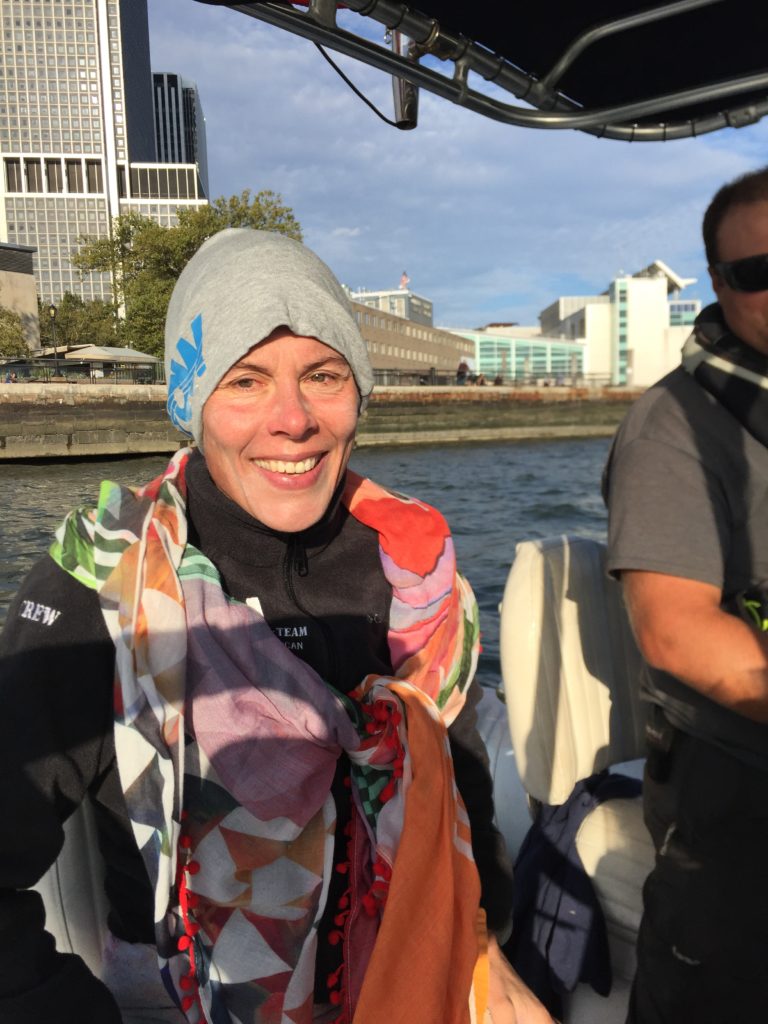
Dana, Janet and myself pre-swim.
Kayaker Alex.
Kayaker Luis.
Boater Sean.
Myself and Courtney.
And we’re off.
The Swim
The Hudson
We splashed off the Coast Guard pier at the Battery at 6:38 AM. The air was about 60˚F, there were patches of clouds, and the water was comfortable in the low 70s. I started stroking and lost sight of Courtney almost immediately. Alex and Luis soon flanked my sides. The water was calm though there was a brisk northerly wind (about 8 mph). We swam along the seawall against the current and slowly passed the landmarks of the Battery: South Cove, North Cove, and Pier 25. When swimming counterclockwise with the current, it takes minutes to pass these locations in the Hudson’s outgoing ebb. It took 40 minutes to swim the mile upriver to North Cove. The flood current was scheduled to start at 7:15, but it was 8 AM before any northward push was felt. At Pier 40, two miles into the swim, we were 25 minutes behind schedule, and at Pier 88, three miles in, we were forty minutes behind. After that the current picked up and, with the wind against current, it was a choppy, joyful ride upriver. Feeds, consisting of a combination of Gatorade, bananas, Gu gels, mini choc-chip cookies, and ibuprofen every two to four hours, came quickly. I welcomed the bouncy water, since I knew it was due to a fast current push.
After 79th Street Boat Basin, I channeled memories of the past years swimming the the NYC Swim Little Red Light House 10K, which went from 79th St to Inwood, north of the George Washington Bridge. Once that course was covered we moved from the fast currents in the center of the Hudson toward the eastern side of the river close to the Inwood Canoe Club. Club member Manuela Jessel delivered coffee and muffins to Alex and Luis, and Richard Lopez accompanied us through Spuyten Duyvil, the headwaters of the Harlem River.
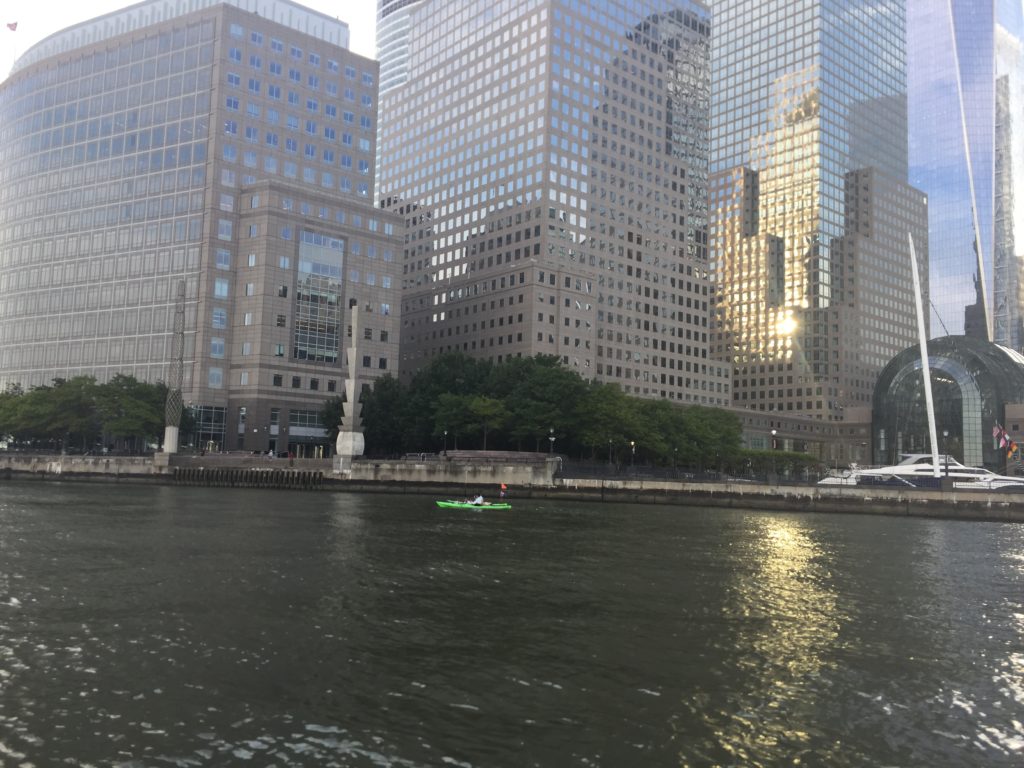
North Cove, Lower Manhattan.
The Harlem
The Harlem River was warm, calm, and sunny and we all let out a whoop of delight to have completed the Hudson after 4.5 hours. I knew that arriving at the Harlem River late meant there would be more time with a push against me on this leg of the course, and it was soon evident that the flood current I was expecting to help me through the first few miles was quickly waning. We arrived in the Harlem at 11 AM and the current turned on or before schedule at 11:55 AM when we were at the 207th Street Bridge, a mere 1.5 miles into the 9 mile stretch. I hadn’t mentally prepared for this scenario and while resting in a lee after Alex and I battled an already brisk current along the eastern sea wall at Roberto Clemente park I said to him “this wasn’t part of the plan”. Alex said “well the plan just changed”. It took an hour to swim another 1.5 miles to High Bridge, all the while the Washington, Alexander Hamilton, and High Bridge overpasses taunted me by looking so near and yet taking so long to reach. I realized the swim could well be over at this point, and if I made it to the East River before her ebb was completed, it certainly wasn’t going to be an 8hr 45 min swim. In any case, it made most sense to keep swimming and see what unfolded.
Spuyten Duyvil, Harlem River
New Yorkers know that by rule of thumb there are 20 blocks to a mile. Luis noted that High Bridge is at 173 Street and the Harlem ends around 100th Street, so it was 3.5 miles more against the current (it’s actually 4.5 miles). With the model now out the window, I calculated I was swimming at about one mile per hour and it would take three hours to swim the remaining 70 blocks of the Harlem. If I got to Mill Rock at 4 PM the swim was finishable, but any later and I would probably not make it down the East River before the end of the outgoing ebb. This is pretty much how things worked out; I was in the Harlem for a total of five hours, arriving at Mill Rock just before 4 PM.
Swimming against the Harlem is the most memorable part of the swim. It’s remaining 11 bridges focused faster waters to flow between the narrowings created by the bridge stanchions. The challenge was to break through these rapid currents and find lees and eddies on the other side of the bridge before encountering the next bridge challenge. Hannah Borgeson, who observed Liz’s swim in 2009, warned me that the narrow channels under the bridges nearest the sea wall had even faster currents that the central channels. Each bridge was a puzzle to solve. Luis and Alex focused hard on the best course to take and I followed their direction, sometimes moving left, then right, and sometimes half way in, turning back and trying a different channel.
Meeting up with Sharon near the Madison Ave. Bridge.
Sharon, Alex, me, Luis.
About half-way through the Harlem, near the Madison Avenue Bridge, friend Sharon Gunderson joined us on a stand-up paddle board. I had wanted Sharon to be on the boat for the swim, but she had other plans, so I was beaming that she could join us, and even better that she was right on the water with me. She radiated warmth, support, and calm. I swam with a smile, so happy to be surrounded by this wonderful team who were helping me on this crazy venture, which as the hours passed and we struggled through more and more of the bridge currents, struck me as being a really bad idea.
Soon Sharon was leading the charge, scouting out the best channels to take under the bridges. The challenges mounted as we passed the Third Ave, Willis Ave, and RFK/Triboro Bridges. I had been warned there was no hiding from adverse currents at the RFK Bridge, though Sharon made the pass relatively easy (even if it was over submerged dock pilings). And there was a jumper just before we went under this bridge, which should have registered from all the flashing police car lights, but I only learned this later, and that the “patient” was ok.
The river broadened and I could see friendly and familiar landmarks of the Hell Gate Bridge and the 103rd Street footbridge. Excitement mounted within that the swim could be completed. At Wards and Randall’s Island we passed under a Ferry dock being repaired to avoid the wash of a NYPD launch pushing against the dock at full throttle. The loud beats and flashing lights of the massive Electric Zoo rave soon serenaded us. Luis and Alex rocked their boats and waved their paddles as they grooved to the beat. It was hysterical. People on the shore looked and pointed at us and it felt like we were in an alternate universe to them. After eight hours of challenging swimming and the intrusion of the city on our tired delirium, the dancing kayakers captured the craziness of this venture.
I hoped see Andy and my kids around this time and they appeared almost miraculously when I stopped to feed before the 103rd street footbridge. It was all smiles at this point. They walked with us as we swam against the current by the rip rap on Randall’s island. Under the footbridge Alex, Luis and I shrieked as signs of the favorable ebb current of the East River were felt. Andy and the kids had to run to keep up with us now and soon we were waving good-bye.
Meeting up with Andy and the kids at Wards/Randalls Island.
The East River
Breaking into the East River ebb was no easy feat. We tried to enter at the tip of Randall’s island, on the east side of Mill Rock, but had to turn back and pass Mill Rocks west bank. At this tidal confluence the water ripped, twisted, turned and sucked. There was small tight chop and then bigger chop. At one point Luis’ kayak was swung 90˚ in seconds and his stern almost whacked me in the head. We all knew to hang on and go with the flow, for the final eight miles would take not much more than an hour to complete in the 3-5 knot currents.
Unsuccessfully trying to break through to the East River on the east side of Mill Rock.
As we entered the East River I was preparing for the loss of Sharon from the team as I assumed she would return to her launch site in the Harlem. However, as we bounced and twisted in the wild flow, she was there by my side, kneeling upright on her paddle board. Imagine someone keeping their balance while standing on a wild bull at a rodeo; Sharon’s yoga master and ladder skills from painting houses were shining through. (I have also watched Sharon paint my apartments ceiling while balancing on one leg on the top wrung of a ladder).
Along Roosevelt Island, where the currents are strongest, we had five foot swells and breaking waves. Momentarily we’d disappear from each-others view while riding over a wave crest or into a trough. We all howled in delight; after the Harlem river what a contrast and reward.
Just before the waves started breaking in the fast ebb of the East River.
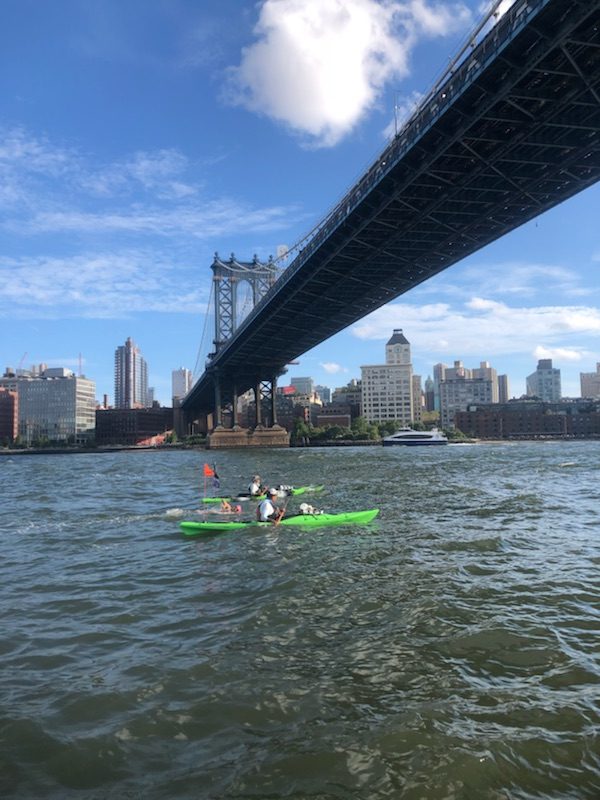
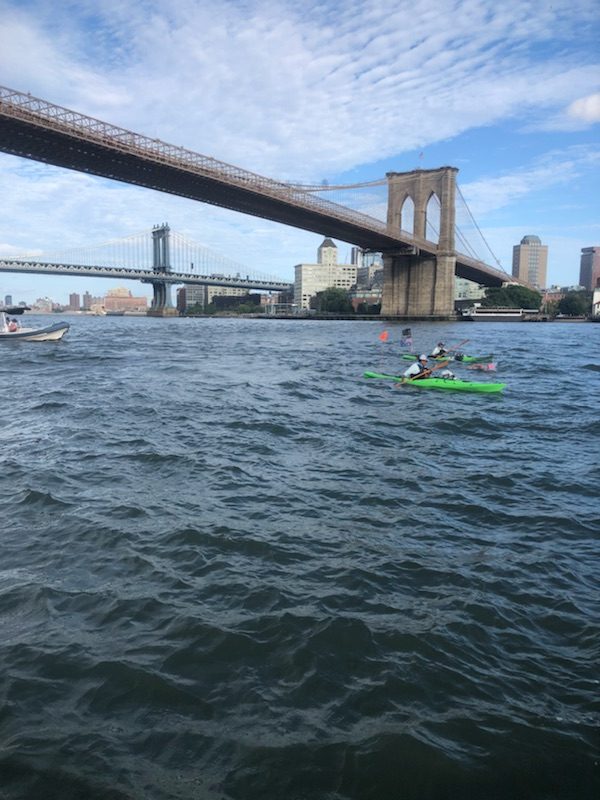
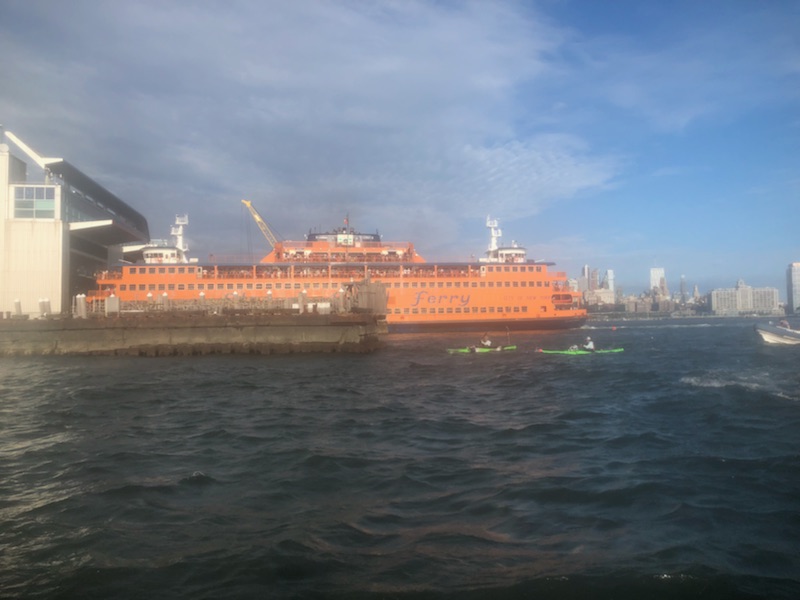
Approaching 34th street the Sun was starting to dip in the sky and cast its glow our way. It felt like the four of us were a formidable, misfit gang cruising down the East River. We flew past the the BMW bridges, but this time in reverse: Williamsburg, Manhattan, Brooklyn. At the heliport I could see the silhouette of the burnt orange Staten Island Ferry docking at the finish point with the Statue of Liberty in the background.
Manhattan Bridge
Brooklyn Bridge
The finish and holding Staten Island Ferry.
Would we need to wait for the ferry to depart? Luis told me to keep swimming. Sean had spoken to the ferry captain and they were holding while I passed the terminal. Passengers were standing at the railings watching me. New York City casts rare and absurd moments when we stop and realize why we love this city. This was one of them. My final time was 11 hours and 17 seconds; forty four minutes faster than the former record and forty minutes ahead of the flood in the East River that would have stopped me in my tracks. I climbed on the RHIB to the embrace of Janet and Dana, elated.
Happy swimmer.
Final Thoughts
All the people mentioned in this write up were part of my team that helped to accomplish this goal. Their vast experience and support is the reason this day was so fun, relaxed, a wonderful experience, and ultimately a success. I am so grateful. As I said to Alex and Luis after riding the white waters along Roosevelt Island “You guys are my heroes. I can’t thank you enough”.
What Happened to Courtney?
Courtney lost valuable time in the Hudson’s flood current when she was forced to move to shore and tread water for 30 minutes while a French war ship docked. She arrived at Spuyten Duyvil with the Harlem against her, and battled the river at Broadway Bridge for many hours until retiring after 11 hours of swimming.
“Did they let you out of the witness protection program?” Dave Barra zinged when I showed up to volunteer for the Ederle Burke Swim last fall. Whereas I used to be part of just about every local open water swim, the group I was most involved with had folded up shop, and other responsibilities and shifting priorities kept me away from the scene the past few years. This year, though, I’d fallen into a good training routine with other distance swimmers, and I knew that a goal would be good for me.
What better goal than Stage 4? I’d done it in 2013 as the third of three back-to-back stages and had the amazing experience of being the only swimmer that day. Under gray skies with Alex as my paddler and Dave on AgentOrange, I wended my way past picturesque islands and promontories of the Hudson Highlands while dodging the occasional storm debris. My family members provided close support for all three days including watching from the shore at different spots.
8 Bridges has grown considerably since then, so I knew I would be sharing the water but still hoped to focus on my own swim. The goal in itself certainly provided a wonderful focus, starting with 100 x 100s on New Year’s Eve. The weeks leading up to event day, it felt great to get back into the swim-organization mode, figuring out all the little logistical details: how to fit in the other long swims, when and where to acclimatize in the open water, which suit to wear, what to tell my paddler in advance, when to go shopping for snacks, when to make giveaway cookies and my chocolate pudding feeds, what bag to use, who to send my GPS tracking link to and how to explain the undertaking to those not familiar, where to meet Team Hannah Banana pals for a post-event dinner back in New York. It is a relief and a privilege to have these “issues” at top of mind rather other personal and worldy concerns.
The day before my stage, the next day’s weather report was calling for morning thunderstorms, and I checked my inbox expectantly for notice of a postponement. None came. Game on. There was a heavy rain the morning of my swim, but it was early and in Manhattan so the only impact was that I didn’t bike to the train station.
The train car I sat in happened to be the same one the pod of 8B paddlers and a few other swimmers boarded a bit south of the start in Beacon. In a brief conversation with Alex, I got the news that Terry O. would be my paddler rather than the preassigned volunteer with whom I’d been in touch. Normally any change in plan rattles me, but this was great news (even though I had confidence in the original assignment) since I’d worked with Terry at many events and knew he’d be a pleasure to swim alongside. “Keep me away from other swimmers,” was my main instruction as I handed off my feeds and a jar of cookies just for him.
During the wait to get on the boat, I felt a bit melancholy that despite being a Hudson Valley native I no longer had relatives who were able to come out. The swim community and the people following the GPS feed remotely are like family, though, and I enjoyed the dockside banter even if I did not participate much.
Soon enough we were on the elegant, quiet Solaris and then under the Newburgh-Beacon Bridge and time to go! I pushed hard at the start in order to find my own patch of water, dodging from side to side of Terry’s kayak, annoyed at times that people seemed too close. Eventually we had enough space for my liking and the sun started to peek out too. The wind, while favorable, resulted in a chop with a challenging rhythm for an hour or so — but with the clearing skies, Bannerman’s Castle with the partly submerged turret that I always think would be a great ice cream stand, and the majesty of West Point, I had plenty of distractions. The hard push was proving sustainable, so I kept it up — a stronger effort than past marathon swims. By the time we rounded the bend, passing some rock outcroppings I didn’t remember from last time, we had a full-on nice day and a perfectly positioned tailwind.
In addition to appreciating the scenery and my extreme good fortune at being able to have such an experience, I occupied my mind by thinking about the upcoming feeds. Canned peaches. A squeeze tube of chocolate pudding (a novelty even gear-geek Terry hadn’t seen before). Advil for an unexpectedly achy shoulder. All good. I was sorry to have worn two caps for warmth, since conditions were plenty toasty, but not sorry enough to stop for an easy adjustment. Terry tried to get me to smile, but I found that I took on water when I grinned, so the smile had to stay inside. Although I did occasionally see another paddler, whom I later learned was not escorting a swimmer, I was satisfied to be back in my own private Hudson.
The swim took 4:40 in good conditions in 2013, so I trained and packed feeds for up to 5:30 figuring that currents, winds, and my increased age could easily make it considerably longer. As we headed through a narrowing straightaway with a view of the Bear Mountain Bridge seemingly pulling the two cliffs together, I started to wonder if contrary to the usual swim experience — where bridges are not as close as you think — the Bear was actually approaching. Armed as ever with data about speed and position, Terry confirmed this to be the case at my 4-hour feed. Nonetheless, I almost stopped short when the shadow “hit” me before I was actually under the bridge. There it was! Backstroke allowed me to appreciate the span, and then much to my dismay the swim was over.
Happily, one more treat was in store: the opportunity to ride the swimmer “sled” at high speed behind the Jetski to get back to the boat! This was an innovation since my last 8B.
Back on the Solaris I finally tuned in to my fellow swimmers. Three of them were already on board and had all broken the course records! I’d accomplished my goal, too, as I was the only finisher in a span of 23 minutes. Talk about keeping clear of others!
Post-race noshing, preening, and chit-chat were jovial as more of the field finished and got back on board. Conditions had been so good that not only did everyone finish but we got to Garrison Landing in time for a train two hours earlier than expected.
The swim and the season leading up to it were all I wanted them to be, and I didn’t mind a bit that I could barely lift my arms over my head the next couple of days. Only later did I come to regret that my successful quest for solitude meant I’d missed one of the last chances to speak with an amazing person who also did that day’s stage. For the rest of us, the water is still there, even if we are not always there for it.
When I signed up for 8 bridges in February of this year, my plan was to train some for stage 6 knowing I’d have a boost with the strong current. Heck, I could even float if need be! I’d enjoy the views and rest content on completing a nice long swim. I guess it’s not really in my nature to “sort of” do something because before I knew it, “training some” turned into joining the Red Tide Masters team, training at distances I hadn’t attempted since college, and signing up for an extra stage (stage 3) just a month before splash time. I was right about the views, wrong about the floating 🙂
Stage 3: Mid-Hudson Bridge to Newburgh-Beacon Bridge
I came into Monday morning excited but nervous for stage 3, knowing that I’d be swimming with a bunch of experienced veteran open water swimmers. At 13.1 miles, this was my longest swim to date. My previous longest swim was 9 miles in the ocean with a RHIB and no kayak. Among the marathon swimming veterans was Charles Van Der Horst, who I met while waiting for the shuttle bus to pick us up. He introduced himself and told me he worked at UNC, which is where I went to grad school. It was a brief introduction and conversation, but Tar Heels always share a special bond.
We were lucky on Monday because the conditions were pretty ideal. There had been rain in the forecast and on Sunday evening, I was nervous the sky would open up in the middle of the swim. Those fears melted away when I felt the sun and jumped into the brisk water at the Mid-Hudson bridge. The start crept up on me so quickly, it felt as if we had been on the Solaris for just a couple minutes before Rondi told us “start is in 45 seconds!” I didn’t have time to think about “what if’s” or how the conditions may effect the swim.
I passed the time watching the Metro North pass along the shoreline, wondering where people are going on a Monday mid morning, knowing that most people I know are at work while I’m in my own little world, gliding down the river. The water felt familiar even though I had never been at this section of the Hudson. It felt as if I belonged there in the here and now, and not back at my desk in midtown. I felt as if I could keep my pace forever as I watched the trains and the trees, buildings and boat clubs pass by. My favorite sights along the river were the large red buoys. I had arrived early in the Hudson Valley the day before and made a trip to Storm King and the sculptures that struck me most were made of a bright red metal which contrasted against the bright blue sky. The red buoys made the same contrast and I couldn’t help smiling as I was cruising through the aquatic version of Storm King.
About 3 hours in, I saw nothing between me and the bridge besides the Solaris and beautiful, flat, Hudson River water. As it began to get cloudy, i felt the fatigue set in. As an accountant by day, it’s probably no surprise I enjoy swimming by the numbers. To help keep myself calmer and focused, I played a little game called “see how much closer the bridge looks after 100 strokes but don’t look at it before then.” While more painful than the beginning, counting the strokes made the time pass quickly, and before I knew it, I was underneath the bridge. My kayaker Alex had been smiling at me between strokes, knowing I was still having a blast. I let out a “woo” as one of my breaths. Stage 3 in 4 hours, 15 minutes!
It might sound a little crazy but I had enjoyed the swim so much that I didn’t want to get out of the water immediately after I had cleared the bridge. I said I would swim to the boat on my own. I accidentally overshot the boat and I gave Alex an extra workout since he had to row me in against the current. Spolier Alert: I definitely had to use the Jetski after stage 6.
Stage 6: New Tappan Zee Bridge to George Washington Bridge
With stage 3 behind me, I was confident going into Friday because I figured the toughest swim on my schedule was over. Although Stage 6 is longer, at 15.7 miles, the current assist is much stronger than the other 6 stages, making it a little “easier.” The 3 days in between gave me rest which I needed, but at the same time, I was ready to get back in as I glanced at the NYOW tracker any time I had a free moment, wondering how the other stages were going.
When Friday finally came, I felt just as ready as before. I took the Metro North up to Tarrytown looking out the window at the river the entire way and thinking about the return trip. When I first jumped in, everything seemed as it was on Monday. The air temperature was warm, the sun was shining, the water felt great, the bridge was beautiful… but none of that seemed to matter as I was dodging waves at every breath. At first I thought, “Okay wind, that was funny for a minute but you need to stop now.” When it continued and I realized it wasn’t going to stop I just got angry. Although the current was ripping, I felt stagnant. I tried to focus on the beauty around me like I had on Monday, but the wind was distracting me from it all. I swallowed so much water the first 45 minutes that I didn’t even make it to my first feed at the 1 hour mark before I had to pause for a break. I couldn’t imagine another 3+ hours like this.
And then while stopped I said something that I’m embarrassed to share. I told Alex “I don’t know if I can do this.” As soon as those words came out of my mouth, I didn’t believe them and I don’t think he did either. i don’t remember his exact response, only that it was hesitant. It was a ridiculous thought. Out of all the possible emotions I could have felt, the overpowering one was anger – at the wind, at myself for even saying that, at the Palisades for looking SO far away. The big difference on this swim as compared to Monday was the fact I’d had expectations that it would be “easy.” So I decided I’d leave those expectations north of Yonkers, although it was easier said than done. The chop became so much less of an issue when i realized “I don’t have experience with this kind of water, this IS the experience.” Compared to the first hour, the middle and end were much “easier” as I improvised my breathing when I saw waves approach. I focused on how good it felt when I was able to breathe without the wind interference, on the occasional and slight lulls in the waves, on the bright sunshine that would occasionally pop out from behind the clouds and illuminate the water while my head was down, and on the little orange flag I saw on the kayak in front of me which started out small and got larger as I crookedly flew down the Hudson towards Yonkers.
I kept seeing lots of residential buildings, some of which looked familiar from looking out the window on the train earlier that morning. Even though I’ve done the Spuyten Duyvil 10k twice, I didn’t recognize it as Yonkers until Alex said we were in the home stretch during one of my feeds. Also on that feed, I could hear Abby cheering me on from the Solaris, urging me to pick up the pace. Her guidance had helped me through my training, and I felt even more thankful to have her by my side during this challenging swim. At this point the little orange flag on the kayak that was behind me wasn’t nearly as little, and I was able to pass it about 10 minutes later. I kept the momentum going when I saw the Spuyten Duyvil Bridge and then La Marina, 2 landmarks that meant I was “so close but so far.” From La Marina, I started to count my strokes again. 100 and the GW was finally gaining size… another 100 and I could clearly see the cars on the bridge. 100, 100, 100… I lost count a couple times. Exhausted, accomplished, happy.
I was contemplating the swim and watching the current as other swimmers began to cross the bridge. The water looked much calmer from this perspective. Suddenly, I saw the police boat, an Agent Orange safety boat, and a jetski ZOOM to the northeast side of the GW bridge in a matter of seconds. In my experience, the volunteers and NYOW organizers emphasize safety in all aspects of each event, from detailed briefings before, to attentive kayakers during, to hypothermia prevention measures for all participants on the safety boat immediately after the swims, and I’m incredibly grateful to each and every one of them. So, it wasn’t surprising that most of us assumed the best when we saw the units go “all hands on deck,” we knew all measures were taken. After learning what a significant role CVDH played in the Chapel Hill community (which is one I’m familiar with) I can’t imagine how difficult this must be for those closer to him and those back at UNC. My heart goes out to his family, friends and loved ones.
Now that it’s been nearly a month since my 29 mile journey down the mighty Hudson, I’ve had more time to reflect and appreciate this challenging experience. In the future, I know I need to work on the mental aspect of this sport just as much as the physical, if not more. As I’ve been looking at future swim odysseys to try, I realize that “perfect storm” swims like Stage 3 was for me are going to be the exception, not the rule. If this sport was easy, then everyone would do it! I swim for both the fun and the challenge, but negative thoughts like the ones I had at the beginning of Stage 6 can sabotage that purpose.
Also, one final thought: I read so much of this blog before deciding to sign up for these swims. If you’re like me and are also reading and debating whether to sign up for one or multiple stages, my advice to you is to stop thinking and just do it! What are you waiting for?
So, a little self-disclosure so the reader can get perspective. I am a 59 year old who is not a gifted athlete; meaning, I was never an a sprinter and really only fared reasonably well in distance pool races. My only gift is between my ears! I train really hard. My reasoning is, I don’t want to complete a marathon swim, or, worse, not complete a swim, and have the thought, ‘I wish I would have.’ That means, that, this year to date, I have swum over 500 miles. I also do weight training once a week, and, I nap as much as I can! Sometimes, I wake up thinking, ‘do I have time for a nap today?’
Ok, now for my experience with NYOW events: I swam stage one of the the 8 Bridges Swim two years ago, 2017. Prior to this, my longest OWS had been 12.5 miles. Stage one is 18.6 miles, and, as I learned, the Mighty Hudson is called that for a reason. She was frisky that day. Started off nice and glassy and then, she got an attitude! We hit a head wind and from about half-way through until the end. Instead of fighting it, I decided to pretend I was having fun rocking and rolling with it. I was once given advice from Janine Serrell and Devon Clifford: “swim happy”, and, so, I did. When I was done, 6 hours or so later, I was elated, grateful and with a deep respect for the Hudson.
A year later….I tackled 20 Bridges. God granted us a beautiful day, little wind and just enough sunshine. (Notice I always us the plural pronoun. None of theses OW Marathon races are completed alone. Our kayakers, race organizers, volunteers and NYPD are all a part of the success of the swim.) The bay was a tad salty and lots of boat traffic was around. Once up the end of the East River, she calmed down and it was like I was swimming in a pool. Just as I was getting a little bored, I turned the corner to meet George (the GW bridge). The Mighty Hudson greeted me and, said, ‘let’s play’. The wind picked up just enough to make it interesting just as I was tiring. The last four hours were more difficult. I did not have any more bridges to look for and I was getting tired. When I finished, I was done, but, so thrilled. I felt patriotic, appreciative and amazed. I met swimmers from all over the world and counted myself blessed and humbled to be among them.
This year…I decided that to ramp it up one more notch would mean swimming back to back marathons. So, I entered Stage 2 and Stage 3 of 8 Bridges. The only thing I changed in my training was to try in the peak of my training, to hit just over 40,000 yards per week. Also, since I had felt depleted last year at the end of 20 bridges, I add more nutrition to my feeds. I added Hammer gel between some of my other feeds. My other feeds were a mix that I bought from Infinit. I called them for a consult and they put together a mix of all the right stuff to get me through a marathon. Settles well in the tummy, too. So, once again, the weather gods were with us and the morning of Stage 2 was beautiful. Little to no wind the whole way. Only the last 6 miles did we experience a slight chop. I felt strong the whole way. If a negative thought enters my head, I replace it with a positive one, such as, ‘ you are lucky enough to get to do this’, or, ‘your goggles are clear and it is a beautiful day’. I also spend most of the time praying for people I know who are going through rough times…And…I do pray for myself!!
Kudos to my kayakers, Terrence O’Malley and Shawn Lauriat (he guided me last year) who guided me expertly and kicked my butt when necessary.
Getting up the next day to tackle another marathon was tough, and the weather was cooler and I was, of course, tired. But, no time for negative thoughts, jump in and let’s get this party started. I was a bit chilly, but not uncomfortably so. And, before I knew it, it was over…4 hours and 30 minutes seemed so much shorter than the 6 hours and 30 the day before.
Wrapping up, I’d say that NYOW events are a must for your bucket list. Expertly, efficiently and safely run. And, I am learning that once I put the training in, I need to let the rest go; Stay positive and grateful.
Originally I did not plan to do stage 6. I wanted to do the spectacular stage 7. Swimming into New York and seeing all the landmarks from the water level – the Statue of Liberty, The Colgate Clock, Empire State Building…I bought Stage 6 when I got a letter from the organizers encouraging the swimmers to do more stages and offering good conditions to those who would.
Stage 6 (15,7 miles) is believed to be an easy one because of the fast and helpful current. The forecast for the day looked good, air temp
23C, water temp about +20, quite comfortable for me. The only thing to worry about was chop, I do not have much experience swimming in choppy waters. On the other hand stage 6 could give me the experience I needed.
The splash was planned for 10:30 which gave enough time to get to the start, put on sunscreen, check the goodie bag with the famous “recycled” T-shirt, talk to Dasha, my kayaker and meet the swimmates. It was good to see my SCAR fellows “Batches” and Andrew Wells, both doing all the stages.
Another exciting thing about 8 bridges was Solaris, the solar-powered boat, that brought us to the start under Tappan Zee bridge. The air felt chilly, the water looked very choppy. Josh suggested a small intro game where everybody should answer a few simple questions: who are you, where are you from, how nervous you are on the scale of 1 to 10, what’s your favorite dish. “I am Professor of Medicine” said Charlie. “Great to have someone like that with us”, replied Josh. This is how I met Charlie and that is the only thing I remember from that intro game as my own nervousness was way above 10.
We jumped into the water and it all began. For me the chop was pretty tough, I could hardly see anything. “Just keep swimming”, that was the instruction given during the brief “your kayaker will find you”. Eventually I was relieved to see Dasha and the nose of her red kayak. The waves were pretty high and very dense. Once It felt like a giant fish fell on my back, so dense were the waves. They say that the scenery along the shore is beautiful but I am afraid I missed most part of the beauty as I was trying to keep my head as low as possible. I drank so much water from the Hudson that during the first couple of feeding sessions I skipped the water to make it easier for Dasha as it was tough for her as well. By the way, I agree with those who says the Hudson water is salty.
After the first hour I started feeling chilly which seemed to me a total nonsense. The air is warm, the water is warm why should it be chilly??? Later the guys said it was because of the head wind which takes the warmth from the surface. But I did not know that when in the water and so kept saying to myself that there was actually no reason to be cold, which as I now think helped a lot. Once I mistook a railway bridge for the GW bridge which was a slight disappointment. To avoid further disappointments I was just swimming from feed to feed until we cleared George Washington bridge and Dasha said we are done.
The majority of my swimmates had already been on Solaris, I was 11 out of 17. I did not look at it as a race, rather as a learning, so I was happy that I completed the stage, wasn’t in pain and even wasn’t too much cold. Almost everyone said they thought of quitting after the first hour, no one quitted.
The tragic end of the story is well-known. I wish I knew Charlie longer and better. From what my swimming friends told me and what I read myself later he was really a remarkable man with a big heart.
Despite the heartbreaking ending I think it was good to do stage 6. It showed weaknesses with which I can work and proved again the huge amount of warmth, friendship and support in the open water swimming community. I still want to swim into New York pass the Statue of Liberty which gives another reason to come to New York and eventually do it. ❤️Stage6 ❤️CDVH